
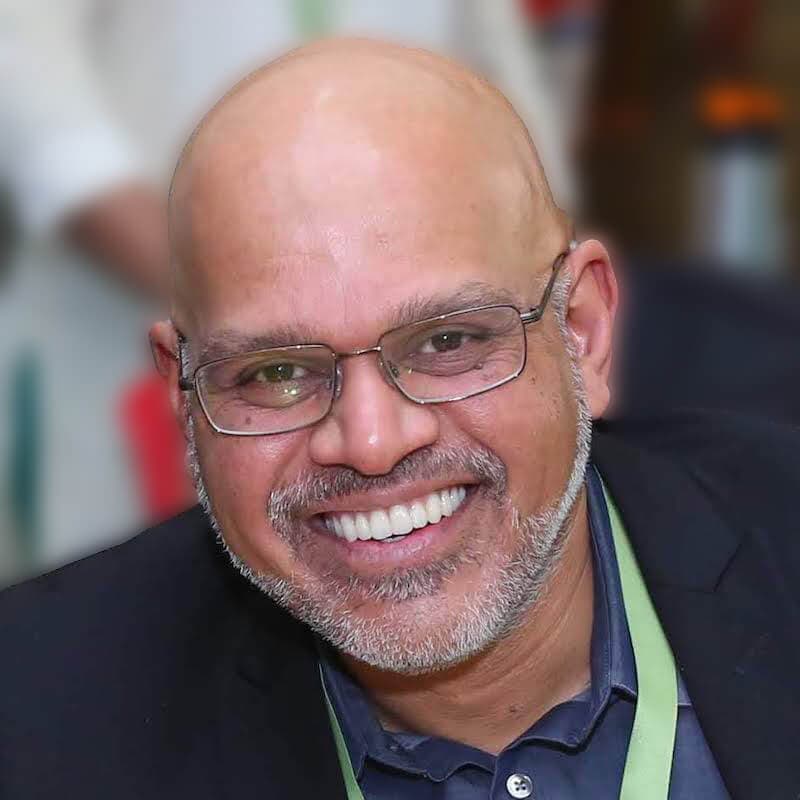
Punya Mishra is Associate Dean of Scholarship & Innovation and Professor in the Mary Lou Fulton Teachers College at Arizona State University (with an affiliate appointment in the Design School). As associate dean, he leads a range of initiatives that provides a future-forward, equity driven, approach to inter/trans-disciplinary educational research. He is internationally recognized for his work in educational technology; the role of creativity and aesthetics in learning; and the application of collaborative, design-based approaches to educational innovation. He has received over $11 million in grants; published over 200 articles and edited 5 books. With over 58,000 citations of his research, he is ranked among the top 2% of scientists worldwide and the top 50 scholars (top 10 in psychology) who have the biggest influence on educational practice and policy in the United States. An AERA Fellow (2024), TED-Ed educator (2023), he co-hosts the award-winning Silver Lining for Learning webinar as well as the Value Laden and Learning Futures podcasts. He is also an award-winning instructor, an engaging public speaker, and an accomplished visual artist and poet. More here…
Must reads
Webinars & Podcasts:
Value Laden (archived)
Apple | Spotify | Simplecast
Blog Posts
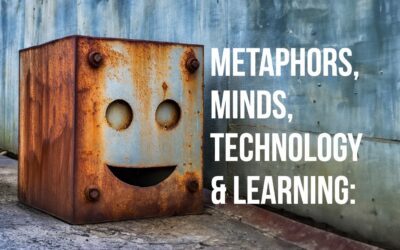
Metaphors, Minds, Technology & Learning
Note: The shared blogging experiment with Melissa Warr and Nicole Oster continues. This time we delve into metaphors of the mind, technology and generative AI. The core idea and first draft came from Melissa, to which I contributed a substantial rewrite. The final...

Who speaks for the university? Social fiction as a lens for reimagining higher education futures
Note: Image above created using Adobe Firefly, Photoshop and composed in Keynote. A few years ago, I had the pleasure of connecting with author Dr. Phoebe Wagner through the Center for Science and the Imagination at Arizona State University. We discussed her...
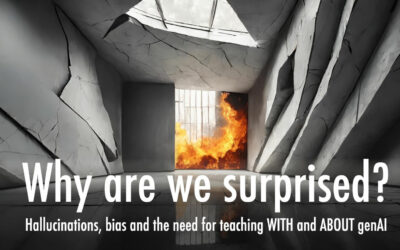
Why are we surprised? Hallucinations, bias and the need for teaching with and about genAI
By Punya Mishra, Melissa Warr & Nicole Oster Note: This is the first post in an experiment at shared blogging by Melissa Warr, Nicole Oster and myself. Over the past months we have found ourselves engaged in some fascinating conversations around genAI, education,...

SITE 2024: A recap
The Society for Information Technology in Teacher Education (SITE) conference has been an integral part of my professional journey for over two decades. My first presentation at SITE was back in 2001 with Matt Koehler and through the years, SITE has played a pivotal...
AI in Education: Potentials, Perils & Policies
NORRAG, based at the Geneva Graduate Institute, is a global network focused on international education policy and cooperation, known for its commitment to addressing under-researched topics related to education quality and equity and amplifying voices from the Global...
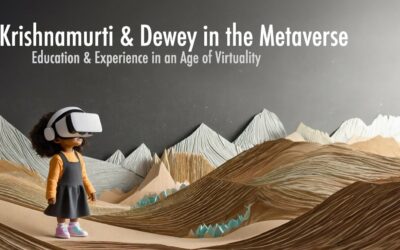
Krishnamurti & Dewey in the Metaverse: Education & Experience in an Age of Virtuality
What does it mean to have an educative experience? As Dewey famously wrote: The belief that all genuine education comes about through experience does not mean that all experiences are genuinely or equally educative ~ John Dewey Questions such as these come to...
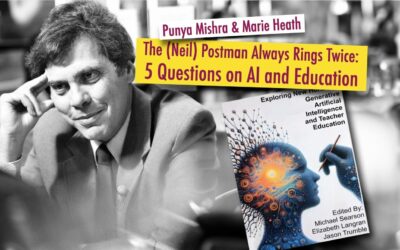
The (Neil) Postman Always Rings Twice: 5 Questions on AI and Education
Note: This post has also been cross-posted on the Civics of Technology blog. Marie Heath (with whom I recently co-wrote a blog post about GenAI in Teacher Education: A techno-skeptical perspective) and I were invited to write a chapter for an edited volume titled...
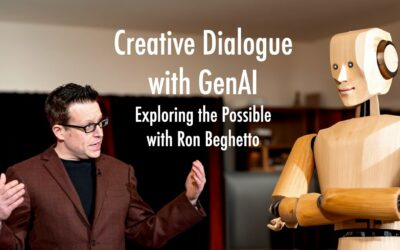
Creative dialogue with Generative AI: Exploring the Possible with Ron Beghetto
As part of our ongoing series for the journal TechTrends exploring the intersections of technology, education, and creativity, we have recently turned our focus to the potential impacts of generative AI (GenAI) on these domains. Our latest article features a...
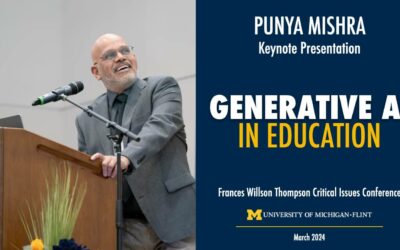
Generative AI in Education: Keynote at UofM-Flint
A couple of weeks ago I was invited to give a keynote at the Frances Willson Thompson Critical Issues Conference on Generative AI in Education. It was great to go back to Michigan even if for a super short trip. One of the pleasures of the visit was catching up with...
… or check out some random blog posts
Celebrating Euler’s birthday
Google has a new doodle out today (the 15th of April) to celebrate the 306th birth anniversary of Leonhard Euler, the Swiss mathematician and physicist. This prompted some reflection on his work (and some mathematical poetry)... At the bottom right of the doodle above...
TE150 & the hope of audacity
Matt Koehler and I were asked to create an audio introduction to TE150 for the ATT and MSU award ceremony, and website. It is amazing what three people can do in a couple of hours, given a microphone and Audacity (the open source audio editing software). Check it out...

Goodbye MSU!
I started working at Michigan State University on the 15th of August, 1998. Today exactly 18 years later I bid MSU farewell to take up a new position as Associate Dean of Scholarship at the Mary Lou Fulton Teachers College at Arizona State University. These last 18...
Teaching TPACK @ BYU
I just found out about IPT287: Instructional Technology for ElEd and ECE a course taught at Brigham Young by Charles Graham (an active TPACK researcher and the adviser of Suzy Cox about whose dissertation I had written about here). Of particular interest to me was a...
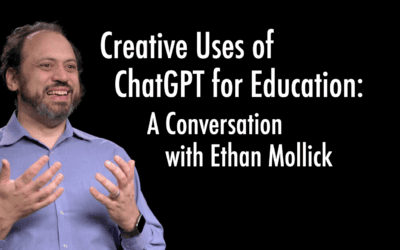
Creative uses of ChatGPT for Education: A conversation with Ethan Mollick
Ethan Mollick is a professor at the Wharton School of Business and studies and teaches innovation and entrepreneurship. He also leads Wharton Interactive, an effort to democratize education through games and simulations. He is also one of the most innovative users of...
Bic to vase: Cool idea
A vase for a daisy, made from a plastic bic pen. (Website here).
SITE 2008, Trust and Digital Technologies
At SITE 2008 Andrea Francis and I presented a paper titled Why some teachers trust digital technologies and other don't? Abstract: Digital technologies have the potential to provide educators with new ways of instructing and learning. However, some educators still...
TPACK Newsletter #9, March 2011
TPACK Newsletter, Issue #9: March 2011 Special Spring 2011 Conference Issue Below please find a listing of TPACK-related papers/sessions that will be presented at the SITE conference in March in Nashville, Tennessee; at the AERA annual meeting in April in New Orleans,...
Orissa Folklore
Just got an email from a fellow Mishra (no relationship, at least I don't know of any), Dr. Mahendra Mishra who works as the state tribal education coordinator in my home state of Orissa as a part of it's Primary Education Program (more at www.opepa.in). Mahendra He...