
Punya Mishra is Associate Dean of Scholarship & Innovation and Professor in the Mary Lou Fulton Teachers College at Arizona State University (with an affiliate appointment in the Design School). As associate dean, he leads a range of initiatives that provides a future-forward, equity driven, approach to inter/trans-disciplinary educational research. He is internationally recognized for his work in educational technology; the role of creativity and aesthetics in learning; and the application of collaborative, design-based approaches to educational innovation. He has received over $11 million in grants; published over 200 articles and edited 5 books. With over 58,000 citations of his research, he is ranked among the top 2% of scientists worldwide and the top 50 scholars (top 10 in psychology) who have the biggest influence on educational practice and policy in the United States. An AERA Fellow (2024), TED-Ed educator (2023), he co-hosts the award-winning Silver Lining for Learning webinar as well as the Value Laden and Learning Futures podcasts. He is also an award-winning instructor, an engaging public speaker, and an accomplished visual artist and poet. More here…
Must reads
Webinars & Podcasts:
Value Laden (archived)
Apple | Spotify | Simplecast
Blog Posts
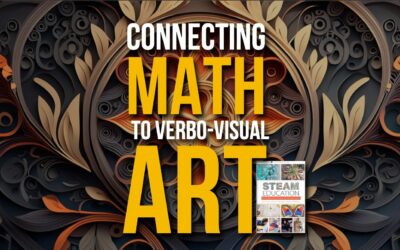
Connecting Math to Verbo-Visual Art: New Publication
Ambigrams are a form of visual wordplay in which words are written/designed such that they can be read or interpreted in multiple ways. Ambigrams exploit how words are written. In doing so, they bring together the mathematics of symmetry, the elegance of typography,...

But is it cheating? AI in Education podcast episode
I was recently invited as a guest on the 3Ps in a Pod, a podcast from Arizona Institute for Education and the Economy at Northern Arizona University and the Arizona K12 Center. I joined hosts Dr. Chad Gestson and Dr. LeeAnn Lindsey to discuss a topic that has been on...

Teacher Knowledge in an Age of Gen AI: SITE 2024 Keynote
16 years ago, Matt Koehler and I were invited to present a Keynote at the Society for Information Technology in Teacher Education (SITE) conference. That keynote changed our lives (link to YouTube video). I was invited back again this year for the same. A lot has...
Metaphors, Minds, Technology & Learning
Note: The shared blogging experiment with Melissa Warr and Nicole Oster continues. This time we delve into metaphors of the mind, technology and generative AI. The core idea and first draft came from Melissa, to which I contributed a substantial rewrite. The final...

Who speaks for the university? Social fiction as a lens for reimagining higher education futures
Note: Image above created using Adobe Firefly, Photoshop and composed in Keynote. A few years ago, I had the pleasure of connecting with author Dr. Phoebe Wagner through the Center for Science and the Imagination at Arizona State University. We discussed her...
Why are we surprised? Hallucinations, bias and the need for teaching with and about genAI
By Punya Mishra, Melissa Warr & Nicole Oster Note: This is the first post in an experiment at shared blogging by Melissa Warr, Nicole Oster and myself. Over the past months we have found ourselves engaged in some fascinating conversations around genAI, education,...

SITE 2024: A recap
The Society for Information Technology in Teacher Education (SITE) conference has been an integral part of my professional journey for over two decades. My first presentation at SITE was back in 2001 with Matt Koehler and through the years, SITE has played a pivotal...
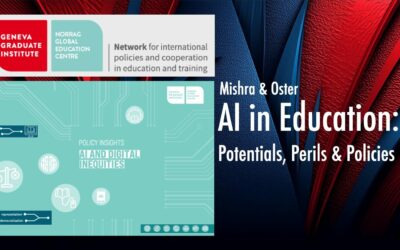
AI in Education: Potentials, Perils & Policies
NORRAG, based at the Geneva Graduate Institute, is a global network focused on international education policy and cooperation, known for its commitment to addressing under-researched topics related to education quality and equity and amplifying voices from the Global...
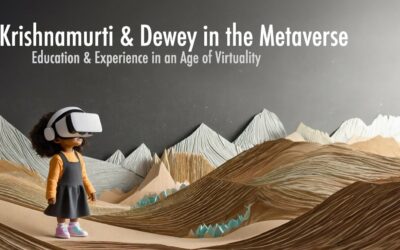
Krishnamurti & Dewey in the Metaverse: Education & Experience in an Age of Virtuality
What does it mean to have an educative experience? As Dewey famously wrote: The belief that all genuine education comes about through experience does not mean that all experiences are genuinely or equally educative ~ John Dewey Questions such as these come to...
… or check out some random blog posts
The Reluctant Fundamentalist
An essay by Mohsin Hamid (titled My reluctant fundamentalist) about the process of writing his novel "The reluctant fundamentalist." What stands out in this piece is an excellent description of the extended and often painful act of creation - in this case a novel. I...
Posthumanizing creativity
Dr. Kerry Chappell is a professor at the University of Exeter’s Graduate School of Education. She merges her training in dance, her doctorate in experimental psychology and interest in education to develop a transdisciplinary research program on better understanding...
Jeff Keltner from Google Education to talk today
There has been a great deal of interest in the educational use of cloud computing tools such as Google Docs in the College (and at MSU at large). Though these tools are often free and easy to use, they come with concerns about intellectual property and ownership of...

GenAI 2023: Year in Review
A week or so ago I was joined by friends Sean Leahy, Rachna Mathur and Kellie Kreiser on the Learning Futures Podcast. The topic: looking back on a crazy, dynamic, transformative year of generative AI. As is to be expected, we covered a lot of ground in the...
Diwali 09 Photos
The Lansing temple recently organized a special Diwali program. My daughter Shreya participated in a dance and I, as always, took photographs of the event. Click here or the image below to see all 161 of the photographs I took. Enjoy. You can also read a poem written...

Multitasking & the learner
One of the myths of the new digital generation is that they are natural multi-taskers. The evidence, however, indicates that multi-tasking is detrimental to performance and success, and though we may try delude ourselves, the fact of the matter is that, we do...
Ask-ing Cuil questions of Google
How do we evaluate a search engine? Chris Wilson attempts to answer this question (with help from the crowd) in his article on Slate "How To Talk to a Search Engine: Three queries to help decide if Google or Cuil or Ask is right for you?" The three search items he...
Exciting new possibility & an invitation
A few days ago we announced a new hybrid Ph.D. program in educational technology. It will be offered substantially online with some critical on-campus face to face factored in. You can find more details of the program by going to the website, or by reading the news...
Chaos theory
PCWorld article on the The 10 Most Disruptive Technology Combinations. As the article says, "Often, even great new technology needs a partner to really change the world. Here are 10 marriages of technologies that have shaken the digital world over the last 25 years."