What can design do for you?

February 4th, 2010 Punya Mishra Posted in Art, Creativity, Design, Film, Good | Bad Design, Representation, TPACK, Teaching, Technology, Worth Reading No Comments »

TPACK involves understanding the capabilities of technology – understanding how we make meaning with it, how we can manipulate it to communicate, engage and teach. I include below an extraordinarily powerful use of media, created with the simplest of tools, one camera, a couple of people and some music. No 3-d aliens, no fancy digital effects – but (and this is important) the designers clearly have a deep understanding of the nuances of meaning that can be generated through subtle yet powerful use of the tools at hand. Zooms and pans, dissolves and wipes, memories and meanings.

Think about this video when people ask of what value are these new digital tools? Tell them we don’t know – but maybe a few years from now someone will surprise us by creating something this touching and breathtaking.

YouTube Preview Image

AddThis Social Bookmark Button

Interesting TPACK related discussion

February 3rd, 2010 Punya Mishra Posted in Creativity, Design, Learning, Philosophy, TPACK, Teaching, Technology, Worth Reading No Comments »

Russ Goerend over at Learning is Life has initiated a fascinating discussion on the TPACK framework on his blog. It all revolves around a blog post he titled The force is strong with the shiny one. I shall not seek to summarize the discussion here (please go read it for yourself) but there are a couple of things he wrote that connected with me and that I would like to comment on. He wrote:

When I think of the TPACK diagram, I picture horseshoe magnets on the outside of each circle, pointed into the middle. Those magnets are what keep the quality teacher balanced in the center, each magnet pulling and building a feeling of equilibrium. This is obviously best-case scenario.

He describes the evolving knowledge of the teacher as (and I love this phrase) Journey to the Center of the Venn. As Matt Koehler and I have written earlier, we see all good teachers as sitting right in the middle of the three intersecting circles. Elsewhere we had written:

Clearly, separating the three components (content, pedagogy and technology) in our model is an analytic act and one that is difficult to tease out in practice. In actuality these components exist in a state of dynamic equilibrium, or as the philosopher Kuhn (1977) said in a different context, in a state of “essential tension.” (This is in our original TC Record article that introduced the TPACK construct, though it was then called TPCK. I am sure we have written about this elsewhere as well, but I am being a bit lazy here.)

Read the rest of this entry »

AddThis Social Bookmark Button

Cellphone in classrooms: The Saline story

February 1st, 2010 Punya Mishra Posted in Creativity, Design, Learning, TPACK, Teaching, Technology, Video, Worth Reading No Comments »

From the Saline Schools, right here in Michigan, comes a video about how teachers and students are using cellphone in the classroom to enhance teaching and learning. Check it out

h/t Superintendent Scot Graden’s Blog

AddThis Social Bookmark Button

Absolutely brilliant video

January 27th, 2010 Punya Mishra Posted in Art, Creativity, Design, Film, Fun, Good | Bad Design, Puzzles, Representation, TPACK, Technology, Worth Reading No Comments »

The Rethink Scholarship is an scholarship for aspiring art directors and designers to Langara College’s Communication and Ideation Design program. This video is to publicize the program.

AddThis Social Bookmark Button

TPACK survey, new journal article

January 24th, 2010 Punya Mishra Posted in Design, Learning, Psychology, Publications, Research, TPACK, Teaching, Technology, Worth Reading, Writing No Comments »

Hot off the press:

Schmidt, D. A., Baran, E., Thompson, A. D.,  Mishra, P.,  Koehler, M.J. & Shin, T. S. (2010). Technological Pedagogical Content Knowledge (TPACK): The development and validation of an assessment instrument for preservice teachers. Journal of Research on Technology in Education, 42(2), 123 – 149.

Abstract: Based in Shulman’s idea of Pedagogical Content Knowledge, Technological Pedagogical Content Knowledge (TPACK) has emerged as a useful frame for describing and understanding the goals for technology use in preservice teacher education. This paper addresses the need for a survey instrument designed to assess TPACK for preservice teachers. The paper describes the survey development process and results from a pilot study on 124 preservice teachers. Data analysis procedures included Cronbach’s alpha statistics on the TPACK knowledge domains and factor analysis for each domain. Results suggest that, with the modification and/or deletion of 18 of the survey items, the survey is a reliable and valid instrument that will help educators design longitudinal studies to assess perservice teachers’ development of TPACK. (Keywords: TPACK, instrument development, preservice teachers)

AddThis Social Bookmark Button

The TPACK game, Littleton version

January 24th, 2010 Punya Mishra Posted in Blogging, Creativity, Design, Good | Bad Design, Learning, Representation, Research, TPACK, Teaching, Technology, Worth Reading No Comments »

I received an email from Michael Porter of the Littleton Public Schools in Colorado about a version of the TPACK game Michael and his colleagues recently conducted with their K-12 Leadership team (building principals and district administrators). I know that Matt Koehler and I had discussed a TPACK mashup game in our SITE 2008 Keynote but what Michael and his colleagues have done is something different. Essentially they gave their participants a set of scenarios that they then had to evaluate using a TPACK lens. They ended up what  a set of “scatter plots” that reveal the manner in which each of the scenarios integrated technology, pedagogy and content. Read the post (The TPACK game) to see just how this plays out.


Photograph of “scatter plot” generated by the TPACK game,
Image credit Littleton Public Schools & Michael Porter

Read the rest of this entry »

AddThis Social Bookmark Button

TPACK Newsletter, #6 Jan-Feb, 2010

January 18th, 2010 Punya Mishra Posted in Learning, Publications, Research, TPACK, Teaching, Technology, Worth Reading No Comments »

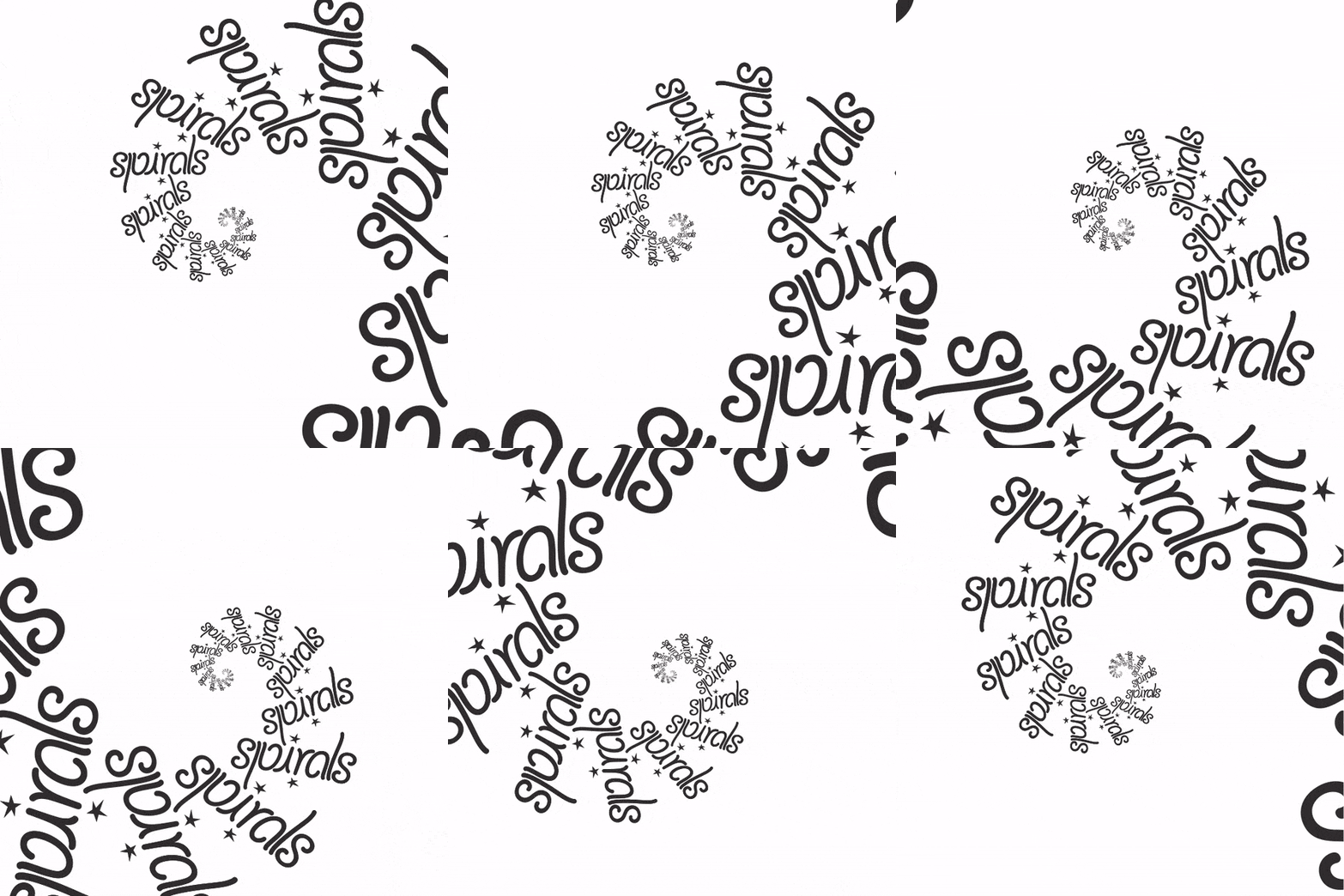
Tpack ambigram logo
TPACK Newsletter, Issue #6, January/February 2010

Welcome to the sixth edition of the TPACK Newsletter, with 642 subscribers (representing a 13% increase during the past 2.5 months), now appearing twice each fall and spring semester. If you are not sure what TPACK is, please surf over to www.tpack.org to learn more.

Gratuitous Quote about Technology
“Technology presumes there’s just one right way to do things and there never is.”  ~Robert M. Pirsig

0. In this Issue:
-2. Introductory Blurb
-1. Gratuitous Quote about Technology
0. In This Issue (You are here.)
1. Recent Journal Articles and Conference Papers about TPACK
2. Recent TPACK-Related Dissertations
3. Join a Fireside Chat about TPACK
4. TPACK @ SITE 2010 Conference
5. TPACK Handbook Reviews
6. The Future is Now … So Now What?
7. Learning and Doing More with TPACK
–. Un-numbered miscellaneous stuff at the end

Read the rest of this entry »

AddThis Social Bookmark Button

Poetry, Science & Math, OR why I love the web

January 12th, 2010 Punya Mishra Posted in Ambigrams, Art, Blogging, Creativity, Film, Good | Bad Design, India, Learning, Mathematics, Personal, Philosophy, Poetry, Representation, Science, Stories, TPACK, Teaching, Technology, Worth Reading 6 Comments »

A 5th grade science assignment, transformed. A rant about Mother Goose. A math poetry challenge!  How did that come to be? And what does that have to do with loving the Interwebs? Read on…

I had written earlier about how my 10 year-old daughter had been writing poems on science (Scientific Poems or Sci-Po’s for short). It all started with an extra-credit assignment she needed to do for her science class, and a need, I perceived, to keep her blog (Uniquely Mine) up-to-date. She has quite a few written now. For instance here is one about a news item about scientists finding dinosaur eggs (and other dino-stuff) in India (Cluster of dinosaur eggs found in southern India), and here’s the poem:

Read the rest of this entry »

AddThis Social Bookmark Button

eduPUNKing a course website!!

January 11th, 2010 Punya Mishra Posted in Art, Creativity, Design, Engineering, Film, Good | Bad Design, Learning, MAET, Online Learning, Philosophy, Research, Stories, TPACK, Teaching, Technology, Worth Reading 6 Comments »

I had written about the EduPunk movement earlier, in fact had even designed a logo for it.

A brief description of Edupunk can be found on Wikipedia (a google search will reveal many more). Wikipedia describes it as follows:

Edupunk is an approach to teaching and learning practices that result from a do it yourself (DIY) attitude. The New York Times defines it as “an approach to teaching that avoids mainstream tools like Powerpoint and Blackboard and instead aims to bring the rebellious attitude and D.I.Y. ethos of ’70s bands like The Clash to the classroom.”

Well, I am no expert on 70’s bands but the EduPunk title does appeal to me. It appeals to me because for the longest tie the main attraction of digital technology, to me, has been this DIY attitude, the fact that I can, over an evening or two, create a stop-motion movie with my kids (here or here), or mashup a commercial, or, in this case, create my own course website. The final product may not have the finish or sheen of a commercial product but it is in some key way “authentic.” It is mine. It embodies me, my sensibility, my approach, my vision in ways that other products can not.

For my entire tenure here at MSU I have constructed my own course-websites, cobbling them together with what I have often jokingly called “duct-tape and magic.” I have even written about this, long before the EduPunk moniker came along (see links at end of post). What I want to describe in this post are my current experiments (for my CEP817 Learning Technology by Design course) using using Wordpress as a learning management system, and boy am I impressed!! [My partner in crime in this is Kristen Kereluik, a graduate student in our program.]

Read the rest of this entry »

AddThis Social Bookmark Button

Teaching to learning styles, what hogwash

December 16th, 2009 Punya Mishra Posted in Learning, Psychology, Representation, Research, TPACK, Teaching, Technology, Uncategorized, Worth Reading 6 Comments »

There is an article in today’s Chronicle titled Matching Teaching Style to Learning Style May Not Help Students.

I have been somewhat skeptical of the learning styles literature for a while, not the least for hearing the phrase being bandied about without much thought. I have heard people claim without much evidence, that today’s kids are visual learners. I have heard a teacher say that as a consequence, that visual learners prefer reading text from a Powerpoint slide, rather than read it on a blackboard! (Those who know me that I am rarely at a loss for words, but that statement truly struck me dumb! In Wolfgang Pauli’s words, that statement was not even wrong.) I have also had students claim that they did not do well in a certain course because it did not match their learning style!

Anyway, the study reported in the article

… does not dispute the existence of learning styles. But it asserts that no one has ever proved that any particular style of instruction simultaneously helps students who have one learning style while also harming students who have a different learning style.

What does this non-finding mean for practitioners (teachers and professors)?

Read the rest of this entry »

AddThis Social Bookmark Button

On picturing words, tech-mix an old school idea

December 11th, 2009 Punya Mishra Posted in Art, Blogging, Creativity, Design, Fun, Learning, Photography, Representation, TPACK, Teaching, Technology, Worth Reading 1 Comment »

Words

Students in my CEP 818 (Creativity in Teaching and Learning) have been using digital photography to explore a variety of topics related to trans-disciplinary creativity. I hope to showcase some of their work on this blog once the semester gets over. In the meanwhile, I received an email from Michael Hughes, a former alumnus of this course, and a teacher in Jakarta, Indonesia. In his email he provided some links to some really cool work his students have been doing.

Read the rest of this entry »

AddThis Social Bookmark Button

Putting technology first

December 8th, 2009 Punya Mishra Posted in Design, Engineering, Evolution, Good | Bad Design, Learning, Philosophy, TPACK, Teaching, Technology, Worth Reading 1 Comment »

Don Norman has a great essay titled Technology First, Needs Last that I strongly recommend. We have been making a similar argument in some of our more recent pieces, see here and here

What do you think of Norman’s ideas? Read it first and come back here to discuss what it means for teaching with technology. Can innovation in teaching only happen when we put technology first? What about content? and pedagogy?

AddThis Social Bookmark Button

All you can cheat, part II (a response)

November 13th, 2009 Punya Mishra Posted in Creativity, Design, Learning, Online Learning, Philosophy, Plagiarism, Psychology, Stories, TPACK, Teaching, Technology, Worth Reading 7 Comments »

Cheating

Patrick Diemer commented on my previous posting, All you can cheat, the web & learning by saying:

Do you have any words of wisdom or resources on how to create appropriate questions? This sounds great, but easier said than done in my humble opinion.

I started writing a response to his comment, but as I wrote on, I realized that it was better as a post in its own right. So here it is…
Read the rest of this entry »

AddThis Social Bookmark Button

All you can cheat, the web & learning

November 13th, 2009 Punya Mishra Posted in Learning, News, Online Learning, Philosophy, Stories, TPACK, Teaching, Technology, Worth Reading 6 Comments »

Now here’s an important story coming out of Denmark: Students in Denmark Allowed Full Access to the Internet During Exams

I have always been a believer in allowing students to use any resources they can during examinations. If we care about authentic assessment, what can be more authentic than that. When I have a question that I need an answer to, or some topic I need to learn about, the first thing I do is go to Google. Why should students be denied that resource? Knowledge today is as much in our brains as it is distributed in artifacts (my laptop) and on the web. So it is heartening for me to read the following:

…the Danish government preach [sic] that the Internet is so much a part of daily life, it should be included in the classroom and in examinations.

With that belief, the government have taken the bold step of allowing full Internet access to several high schools during their final year exams. The implications of this are significant, particularly for the kinds of questions we ask in such exams. Clearly these have to change. No longer can we ask simple factual questions the answers to which can be easily found on the web. We have to ask questions that push students to compare and contrast opposing points of view, questions that push them to think critically about information, questions that push them to come to their own conclusions based on the information they can find.

I am not sure the Danish authorities have gone that far, yet. At least the story does not describe how assessment has changed. Their approach seems to be to constrain significantly the amount of time students have. As the story says:

Surprisingly, students themselves admit it’s not easy to cheat using the Internet during an exam. According to the JP news agency, students are given a very short period of time in an exam to sift through the mounds of data they can call up on the Internet to answer a single question.

One can argue that this is somewhat authentic, given that we often have limited time to come up with answers to questions.

Read the rest of this entry »

AddThis Social Bookmark Button

Keep TPACK clean :-)

November 9th, 2009 Punya Mishra Posted in Design, Fun, India, Orissa, Personal, Photography, TPACK, Travel, Worth Reading 1 Comment »

I came across this sign when I was in India recently and I just HAD to take a picture of it.

Keep TPACK Clean
Click on the picture for a larger version

Of course, much of the effect comes from the inadvertent yet appropriate peeling of the paint from the letter “R.” But fun nonetheless.

AddThis Social Bookmark Button

TPACK moving in international circles

November 1st, 2009 Punya Mishra Posted in Learning, News, Publications, Research, TPACK, Teaching, Technology, Worth Reading 1 Comment »

My friend, Martin Oliver, over at the London Knowledge Lab sent me the following link about a TPACK related publication that appeared in the International Journal of Education and Development Using Information and Communication Technology, aka IJEDUICT. (Boy, that’s a long name for a journal, and I dare you to pronounce the acronym.) As it turns out, I was not acquainted with this journal. A quick browse showed that it had a strong international authorship and readership. Sadly most of my publications (with a few exceptions) have been in US journals, and doubly sadly, most authors published in US journals are from US universities. This is so parochial and a pity because there is a lot that we can all learn from each other, especially in a field like Ed Tech.

Any a bit of TPACK-searching on the journal website led to three separate mentions (technically there are two since one of the mentions was in an editorial describing an article in that very issue that utilized the TPACK framework). Anyway, for the record here are the citations (and links).
Read the rest of this entry »

AddThis Social Bookmark Button

TPACK newsletter #5, Oct – Nov 09

November 1st, 2009 Punya Mishra Posted in Learning, MAET, Online Learning, Publications, Research, TPACK, Teaching, Technology, Worth Reading No Comments »

Got TPACK image

TPACK Newsletter, Issue #5: October/November 2009

Welcome to the fifth edition of the TPACK Newsletter, now with 568 subscribers (representing a 15% increase during the last two months!), and appearing bimonthly between August and April. If you are not sure what TPACK is, please surf over to www.tpack.org to learn more.
Read the rest of this entry »

AddThis Social Bookmark Button

AACTE Webinar series coming up!

October 15th, 2009 Punya Mishra Posted in Conference, Creativity, Design, Learning, Online Learning, Research, TPACK, Teaching, Technology, Worth Reading 2 Comments »

I chair the committee on Innovation & Technology of the American Association for Innovation & Technology (AACTE). The committee has been working hard with people over at AACTE (Rachel Popham deserves a big shout out) in organizing a webinar series coming up November 17th – 19th. Here’s a description:

AACTE Webinar

This webconference addresses creative teaching and learning in the digital age. Designed within the Technological Pedagogical Content Knowledge (TPACK) framework these sessions by top-notch scholars, researchers and practitioners will cover a range of topics: including the educational potential of social networking, the expanding use of GPS, intelligent use of video to teach science, and the role of cloud computing in face to face and online classes. The goal is to help participants think creatively about integrating multiple technologies into varied teaching and learning contexts.

Readers of this blog will find a familiar name, Sean Nash of Nashworld as one of the presenters!! I may be moderating one of the sessions though that is still being worked out. So lock in these dates and you can find out more by going to the AACTE website.

AddThis Social Bookmark Button

TPACK newsletter #4, Aug – Sept 09

October 8th, 2009 Punya Mishra Posted in Conference, Housekeeping, Learning, Online Learning, Publications, Research, TPACK, Teaching, Technology, Worth Reading No Comments »

got tpack


Welcome to the fourth edition of the TPACK Newsletter, now with 494 subscribers (representing a 36% increase during the last four months!), and appearing bimonthly between August and April. If you are not sure what TPACK is, please surf over to www.tpack.org  to learn more.

Gratuitous Quote about Technology

"My theme for philanthropy is the same approach I used with technology: to find a need and fill it.”
- An Wang


In this Issue:
-2. Introductory blurb
-1. Gratuitous Quote about Technology

0. In this issue (You are here.)
1. Recent TPACK Articles
 
2. TPACK-in-a-text(book)
 3. (Sort of) Recent TPACK Articles

 4. Recent TPACK Presentations

 5. TPACK Podcasts

 6. TPACK Research in Progress

 7 TPACK Professional Development
8. Recently Completed TPACK-based Dissertations & Theses
 9. Learning and Doing More with TPACK
–. Un-numbered miscellaneous stuff at the end

1. Recent TPACK Articles

TPACK was a “Top Story” on August 26, 2009 in both eSchoolNews and eCampusNews! A feature article (“TPACK explores Effective Ed-Tech Integration”) written by senior editor Laura Delaney explained TPACK and its components in considerable detail, plus one way of helping teachers to develop TPACK: using curriculum-based learning activity types. Punya, Matt, Judi, Mark Hofer, and Karen Richardson were interviewed and provided the content for the feature stories.

Hot off the press! Judi Harris & Mark Hofer’s Feature and Learning Connections articles are appearing in the September/October 2009 issue of Learning & Leading with Technology. “’Grounded’ Technology Integration: Planning with Curriculum-Based Learning Activity Types” introduces a TPACK-based approach to technology integration during instructional planning, and “’Grounded’ Technology Integration Using Social Studies Learning Activity Types” illustrates how to do this in the social studies. Watch future 2009-2010 issues of L&L for more Learning Connections articles about math, world languages, science, K-6 literacy, and English language arts activity types, written with collaborators Neal Grandgenett, Marcela van Olphen, Meg Blanchard, Denise Schmidt, and Carl Young.

This summer, Judi, Punya & Matt published an overview of TPACK, emphasizing the roles of content and technological content knowledge, and how to help teachers to develop it, in the Journal of Research on Technology in Education, vol. 41, no. 4, PP. 393-416. The article is entitled, “Teachers’ Technological Pedagogical Content Knowledge: Curriculum-based Technology Integration Reframed.”

A few months earlier, Hyo-Jeong So (Nanyang Technological University) and Bosung Kim (University of Missouri) published the results of a study that “examined perceived difficulties and concerns that pre-service teachers encountered when applying their knowledge on technology, pedagogy and content to design a technology integrated lesson.” They utilized a collaborative lesson design similar to Matt & Punya’s Learning by Design approach to developing TPACK. The article, “Learning About Problem-based Learning: Student Teachers Integrating Technology, Pedagogy and Content Knowledge,” was published in the Australasian Journal of Educational Technology, 25(1), PP. 101-116. A .PDF of the article is available for your perusal.

2. TPACK-in-a-text(book)

Candace Figg (Brock University) and Jenny Burson (LeTourneau University) are pleased to announce a new arrival: their TPACK-based preservice text, Designs for UnPacking Technological Pedagogical Content Knowledge (TPACK): A Handy Guide for Teaching with Technology, which will be released on September 5, 2009 by Soleil Publishing. Additional information about the book, including sample pages and a table of contents, is available online.

3. (Sort of) Recent TPACK Articles

Two recent issues of Contemporary Issues in Technology and Teacher Education (CITE) featured articles on TPACK. In a special issue devoted to TPACK (volume 9, issue 1), six articles appeared:

TPACK:  A Framework for the CITE Journal
G. Bull & L. Bell

Mathematics Teacher TPACK Standards and Development Model
M. L. Niess, R. N. Ronau, K. G. Shafer, S. O. Driskell, S. R. Harper, C. Johnston, C. Browning, S. A. Özgün-Koca, & G. Kersaint

Teaching Science with Technology: Case Studies of Science Teachers’ Development of Technology, Pedagogy, and Content Knowledge 
S. S. Guzey & G. H. Roehrig

Strategies for Preparing Preservice Social Studies Teachers to Integrate Technology Effectively: Models and Practices
T. Brush & J. W. Saye

What Is Technological Pedagogical Content Knowledge? 
M. J. Koehler & P. Mishra

Examining TPACK Among K-12 Online Distance Educators in the United States
L. Archambault & K. Crippen

In volume 9 issue 2 of CITE, three TPACK-based articles appeared:

Mathematics Teachers’ Development, Exploration, and Advancement of Technological Pedagogical Content Knowledge in the Teaching and Learning of Algebra 
S. Richardson

Giving, Prompting, Making: Aligning Technology and Pedagogy Within TPACK for Social Studies Instruction
T. C. Hammond & M. M. Manfra

Enhancing TPACK With Assistive Technology: Promoting Inclusive Practices in Preservice Teacher Education
M. T. Marino, P. Sameshima, & C. C. Beecher


4. Recent TPACK Presentations

Maggie Niess (Oregon State University) will present a paper entitled “Mathematics Teacher TPACK Standards and Revising Teacher Preparation” at the 10th International Conference of The Mathematics Education Into the 21st Century Project, “Models in Developing Mathematics Education,” which will take place on September 11-17, 2009 in Dresden, Saxony, Germany.

Bill Bauer, the Director of Music Education at Case Western Reserve University, will be presenting “Music Teachers and Technology: The TPACK Framework" at the Society for Music Teacher Education’s 2009 Symposium on Music Teacher Education: Enacting Shared Visions, September 10-12, 2009 at the University of North Carolina at Greensboro.

There were several TPACK-based sessions at the National Educational Computing Conference (NECC) in Washington, DC in late June 2009:

We learned about a fascinating paper about helping teachers to develop TPSK – technological pedagogical statistical (and probability) knowledge – that was presented at the 2009 Conference on Research in Undergraduate Mathematics Education in February. A .pdf of the paper, “Preparing to Teach Mathematics with Technology: Lesson Planning Decisions for Implementing New Curriculum,” written by Sarah Ives, Hollylynne Lee, and Tina Starling (North Carolina State University) is available online for your perusal.

Last but certainly not least, we discovered presentation slides by Dan Maas, Chief Information Officer for the Littleton Public Schools in Colorado, which interpret TPACK vis-à-vis 21st-century technologies. An entry in Dan’s blog explains that these slides supported a reflective exercise for educators that focused on “inspired writing.”

5. TPACK Podcasts

"Understanding TPCK," one of the "Teaching in the 21st Century" series of weekly podcasts for teachers, was posted recently by the Maine School Administrative District 75. The podcast explains TPACK and provides examples of TPACK in practice, in which 21st technologies were repurposed creatively for educational use. For example, in Bill’s English class students used Twitter to create microblogs to discuss the books that they’re studying.  This podcast was created in response to Matt & Punya’s feature article in the May issue of Learning & Leading with Technology, “Too Cool for School? No Way! Using the TPACK Framework: You Can Have Your Hot Tools and Teach with Them, Too.” All podcasts in the series are produced and edited by students in MSAD 75’s middle and high school.

A thoughtful and thorough podcast prepared by Ruben Puentedura for the Maine Learning Technology Initiative Fall Teacher 2008 Leader Institutes was shared recently by Lydia Leimback in her blog, "Teacher Tech." Dr. Puentedura introduces and explains two conceptual models that can be used together: TPACK and SAMR. SAMR stands for Substitution, Augmentation, Modification, and Redefinition, which focus upon the roles that digital technologies play in changing the nature of students’ learning, when compared to the use of more traditional technologies for the same or similar learning activities. Illustrative examples of higher education courses are provided to show how TPCK and SAMR can work together in designs for students’ learning. A transcribed version of the podcast is also available.


6. TPACK Research in Progress

Julie Mueller (Wilfrid Laurier University) is currently examining pre- and post- questionnaire, interview, and observation data generated with teachers, administrators, and students as part of an elementary school-initiated laptop integration project, using TPACK as her theoretical framework.   The preliminary results of this study suggest that teachers do indeed consider all of the components of TPACK when planning and providing instruction, but they are not always integrated.  In addition to identifying behavioral measures of TPACK (which Julie feels are much-needed at present in TPACK research), student outcomes will be used to measure the impact of the laptop integration.  Julie hopes to present the results of this project at SITE 2010

Ghaida Alayyar, a doctoral student at the University of Twente working with her supervisors, Drs. Petra Fisser and Joke Voogt, is studying the use of TPACK as a framework to change the nature of preservice science education in Kuwait. Joke writes, “The current curriculum for prospective student- teachers in Kuwait is characterized by a teacher-centered approach and only has an optional course on basic technology applications. The content of the new course is based on the ideas of TPACK. In the first phase of the study (currently underway) a group of 50 science students is designing elementary science technology applications in small groups (3-4 persons). They are coached by subject matter, pedagogical and technology experts. …In the second phase of the study, a new group of prospective students will be involved, with part of the coaching happening via a Web-based support system. Data about student-teachers’ TPACK competencies will be collected before and after the course with the TPACK survey developed by Schmidt, Baran, Thompson, Koehler, Mishra & Shin.”

Are you researching TPACK? Please consider adding a description of your research methods to the TPACK wiki’s “Researching TPACK” section and/or sending us a brief overview of your ongoing work to share in this newsletter.


7. TPACK Professional Development

As mentioned in the first TPACK Newsletter (January 2009), Craig Cunningham reports that the faculty at National-Louis University in Chicago were involved in a Faculty Senate-funded TPACK faculty development project during the 2008-2009 academic year.  In the project, small groups of teacher-education and subject-matter faculty worked with technology “experts” from the faculty to develop ways to integrate technology, pedagogy, and content knowledge.  The various groups worked on topics such as using video to teach interviewing techniques, using Web cameras to conduct live chats with science experts, and ways to better use interactive whiteboards.  Faculty enthusiasm for the project at the end of the year led to the submission of a renewal grant for 2009-2010, which was recently awarded!  The second year of the project will continue the work of the first year, with the addition of a monthly series of TPACK-based seminars designed to increase faculty expertise across the university.   For more information, please contact arlene.borthwick@nl.edu or craig.cunningham@nl.edu.


8. Recently Completed TPACK-based Dissertations & Theses

Chauser, J. (2009).  Instruction 2.0: Effective education for the 21st century. Master’s thesis, National University.

In this thesis, Jacqueline describes the design and implementation of a professional development course for teachers. Building on the TPACK framework, the course encourages an integrated approach to using technology for instruction and respects the interconnectedness of the three knowledge bases required for such integration.

Richardson, K. W. (2009). Looking at/looking through: Teachers planning for curriculum-based learning with technology. Doctoral dissertation, College of William & Mary.

The literature related to teacher planning practices is, for the most part, several decades old. As such, it fails to take into consideration both the proliferation of digital technologies in schools, as well as new frameworks for understanding teachers’ knowledge. This interpretivist study drew upon the Technological Pedagogical Content Knowledge (TPACK) framework (Mishra & Koehler, 2006) to study teachers’ lesson planning processes. Specifically, it focused upon 12 fifth, sixth and seventh grade content area teachers from three southeastern U.S. School districts as they planned for and used digital technologies during lessons in their classrooms. Participating teachers had a variety of professional experiences and placements and had participated in educational technology professional development. They were interviewed about the processes they used to plan instruction, focusing upon how they determined which technologies might be used. In addition, sample technology-infused lessons were observed to see how the plans were put into action.

Terpstra, M. A. (2009). Developing Technological Pedagogical Content Knowledge: Preservice teachers’ perceptions of how they learn to use educational technology in their teaching.  Doctoral dissertation, Michigan State University.

This study uses activity theory and current conceptions of knowledge for teaching content with technology to analyze the working knowledge and experience of a group of seven preservice teachers in order to yield insights into how preservice teachers learn to teach with technology. Findings showed that the preservice teachers exhibited more TK than TPK and TPACK. A developmental trajectory of learning to teach with technology is suggested that takes into account knowledge exhibition and breadth.

9. Learning and Doing More with TPACK

Interested in learning more about TPACK or getting more involved in the TPACK community?  Here are a few ideas:

Feel free to forward this newsletter to anyone who might be interested in its contents. Even better, have them subscribe to the TPACK newsletter by sending a blank email to sympa@lists.wm.edu , with the following text in the subject line: 
subscribe tpack.news FirstName LastName 
(of course, substituting their own first and last names for ‘FirstName’ and ‘LastName’ — unless their name happens to be FirstName LastName, in which case they can just leave it as is). 


If you have a news item that you would like to contribute to the newsletter, please send it to: tpack.news.editors@wm.edu 


If you are interested in volunteering to help run the newsletter (we need help!), send email to: tpack.news.editors@wm.edu

Standard End-Matter

If you have questions, suggestions, or comments about the newsletter, please send those to tpack.news.editors@wm.edu .


If you are subscribed to the tpack.news email list, and — even after reviewing this impressive publication — you prefer not to continue to receive the fruits of our labors, please send a blank email message to sympa@lists.wm.edu , with the following text in the subject line:  unsubscribe tpack.news 


Have a great new school year, everyone!  We’ll be back in late October with issue #5 of the TPACK Newsletter.


- Judi, Matt, Mario, and Punya


Judi Harris,                   Chair, College of William & Mary

Matt Koehler,               Vice-Chair, Michigan State University
Mario Kelly,                 Futon, Hunter College

Punya Mishra
,              Recliner, Michigan State University

AddThis Social Bookmark Button

San Diego Unified School District embraces TPACK

September 22nd, 2009 Punya Mishra Posted in Learning, Personal, Philosophy, Publications, Research, TPACK, Teaching, Technology, Uncategorized, Worth Reading 2 Comments »

I had written recently about TPACK being the top story on eSchoolNews (see TPACK is top story on eSchoolNews or go directly to the article: TPACK explores effective ed-tech integration). What I didn’t realize at that time is that there were actually three stories about TPACK, one in August that I had blogged about and two in Septmber. The two that I had missed were actually more interesting to me personally since they dealt with the manner in which the TPACK framework was actually being used in schools. Both these stories deal with the manner in which the San Diego Unified School District is embracing the idea of TPACK as a key piece of their strategy to transform how their students are taught.

These two other articles (also written by Senior Editor Laura Devaney) are titled (a) San Diego explores effective ed-tech integration through TPACK: New professional development model focuses on the intersection of technology, pedagogy, and content knowledge; and (b) Reinventing education: As schools nationwide examine new federal priorities, San Diego unveils a five-year plan to transform the way students are taught

This news makes me extremely happy, for the simple reason that this means that our ideas have moved beyond graduate school curricula, beyond research articles, beyond doctoral dissertations into actual practice. This is every educational researcher’s dream. Here are some key quotes from these articles.

The San Diego Unified School District (SDUSD) has embraced a concept called Technological Pedagogical Content Knowledge (TPACK) in its professional development model, to ensure that the smart use of technology drives every aspect of classroom teaching and learning.

As technology becomes an increasingly important tool for teaching and learning, this relatively new concept, which focuses on how educators can integrate technology effectively into their instructional practices, is making its way into pre-service and in-service teacher education programs.

TPACK is based on the work of Punya Mishra and Matthew Koehler, both associate professors of educational technology in the College of Education at Michigan State University.

Here’s another:

“We worked closely with the [district] Educational Technology department to design a professional development program that is all-encompassing,” LaGace said. “When you look at the TPACK model, it gets around to improving the whole classroom experience. … It puts the focus not on teaching teachers how to turn on a Promethean Activboard, but why to turn it on.”

Why turn it on? What a profound question, and one that hopefully will be asked by every teacher in San Diego.

Can you guess why I love my job? :-)

AddThis Social Bookmark Button

Unpacking TPACK, the book

September 15th, 2009 Punya Mishra Posted in Books, Learning, Publications, TPACK, Teaching, Technology No Comments »

Candace Figg & Jenny Burson have just released a book titled: Designs for Unpacking Technological Pedagogical Content Knowledge (TPACK), making this the second textbook that utilizes the TPACK framework. You can find out more about the Figg & Burson book by going to its website, here; and about the previous textbook by going here.

Unpacking TPACK book Figg & Burson

I haven’t had a chance to read the book as of yet, but from one of the pdfs on the site this is what I could find:

The book introduces you to instructional design for tech-enhanced lessons based on research about teacher knowledge. The knowledge a teacher needs in order to teach has been summarized as the combination of understanding about pedagogy and the content area so that the teacher understands how to use pedagogy in that particular content area (Shulman, 1986). In the last few years, that model has been expanded to include technology, so that a teacher who understands how to teach with technology understands the pedagogy for teaching with the tool and learning with the tool in that content area (Mishra & Koehler, 2006)—called Technological Pedagogical and Content Knowledge (TPACK). This book presents the practical applications of what TPACK looks like in daily classroom practice so teachers new to teaching with technology can successfully plan and implement lessons that are tech-enhanced. Therefore, in-depth lesson plans for five models of teaching (Direct Instruction, Direct Instruction using Cooperative Groups in Centers or Concept Mapping, Project-Based Learning, Problem-Based Learning in Collaborative Groups, and DGI) are presented so teachers new to teaching will see exactly how to write up a tech-enhanced lesson. As well, there are a dozen other lesson designs suggested to demonstrate how to sequence activities within these models of teaching.

We had said this before, and maybe it needs to be said again:

The fact that an idea ends up in a textbook means not just that it has been accepted by the field but also that the idea is no longer considered controversial or worthy of debate. A feeling of mustiness comes in the air… A gain in authority goes hand in hand with a rise in sterility and a loss of flexibility. Ideas in textbooks seem to somehow end up as being bullet points, lacking the suppleness and evocative richness of the original ideas. Becoming part of the establishment has its risks.

Maybe it is time for Matt Koehler and me to begin a rebellion against narrow, ivory-tower, academic frameworks that try to contain the complexity of educational technology integration in three overlapping circles :-)

AddThis Social Bookmark Button

Jugaad, educational toys from Junk (TPACK at work)

September 14th, 2009 Punya Mishra Posted in Art, Creativity, Design, Engineering, Fun, Games, Good | Bad Design, India, Learning, Philosophy, Puzzles, Science, TPACK, Teaching, Technology, Worth Reading 1 Comment »

sextant

I had written earlier about the idea of Jugaad, the quintessential Indian idea of situational creativity. One of the masters at this is Arvind Gupta. Check out his website for tons of wonderful science toys and experiments that can be made from stuff we typically throw away. Very cool and a critical part of the kind of repurposing of artifacts we need for creative teaching.

Throwaway Technology, playful Pedagogy and powerful Content… who says TPACK needs hi-tech!

Via Major Fun (aka Bernie DeKoven) comes Arvind Gupta, winner of the Defender of the Playful Award.

AddThis Social Bookmark Button

TPACK (and friends) in T.H.E. Journal.

September 9th, 2009 Punya Mishra Posted in Learning, TPACK, Teaching, Technology No Comments »

Matt Townsley sent me an email this morning informing me about a TPACK sighting in THE journal. Well… actually it’s a journal whose title is THE journal! Does that make sense?

Anyway, T.H.E. Journal (Transforming Education Through Technology) has an article by Dian Schaffhauser titled 21st Century Teaching: Which Came First – The Technology or the Pedagogy? which mentions the TPACK framework within the context of teacher education and teacher professional development. Also quoted in the article are two of my most respected colleagues and friends, Glen Bull from University of Virginia and Ann Thompson from Iowa State University. Here is a key quote:
Read the rest of this entry »

AddThis Social Bookmark Button

Tech Trends, Special Issue on TPACK

September 9th, 2009 Punya Mishra Posted in Creativity, Housekeeping, Learning, News, Publications, Research, Science, TPACK, Teaching, Technology, Worth Reading, Writing 3 Comments »

TechTrends is a leading journal for professionals in the educational communication and technology field and is the official publication of the Association for Educational Communications and Technology (AECT). The current issue has 5 articles devoted to the TPACK framework (including one by yours truly with Matt and Kristen Kereluik). I am providing titles and key quotes from each (with a link to the article written by us).

Mishra, P., Koehler, M. J., & Kereluik, K. (2009). The song remains the same: Looking Back to the Future of Educational Technology. TechTrends, 53, 5. p. 48-53.

The TPACK framework emphasizes the role of teachers as decision makers who design their own educational technology environments as needed, in real time, without fear of those environments becoming outdated or obsolete. Using this approach, teachers do not attend to specific tools, but instead focus on approaches to teaching that endure through change in technologies, content, or pedagogies. Teachers with flexibility of thought, a tolerance for ambiguity, and willingness to experiment can combine traits that perfectly design and tailor their own educational content, pedagogical, and technological environments.

David Passig recently wrote on the topic of melioration, or “the competence to borrow a concept from a field of knowledge supposedly far removed from his or her domain, and adopt it to a pressing challenge in an area of personal knowledge or interest” (2007)… According to Passig, melioration is a skill that affords teachers the flexibility to experiment with a vast array of technologies to meet their specific educational needs. Novel frameworks and concepts like TPACK and Passig’s melioration are starting to look at educational technology in a new way. These new perspectives focus on overarching cognitive skills, competencies, and creativity rather than technical understanding and functional knowledge of specific technologies

Read the rest of this entry »

AddThis Social Bookmark Button

TPACK in a podcast

August 28th, 2009 Punya Mishra Posted in Learning, Publications, Representation, Stories, TPACK, Teaching, Technology 1 Comment »

Just discovered a podcast on TPACK (titled Understanding TPCK) at the msad75mltinews website. It appears to be based on the article (Too cool for school) that was recently published in Learning & Leading with Technology.

AddThis Social Bookmark Button

TPACK is top story on eSchool News

August 26th, 2009 Punya Mishra Posted in Learning, News, Research, TPACK, Teaching, Technology No Comments »

I just discovered that TPACK made the Top Story of the Week for Educators on eSchool News!

Written by Laura Devaney, Senior Editor of eSchoolNews the article is titled, TPACK explores effective ed-tech integration. It is a pretty comprehensive piece with quotes from Matt and me, as well as Judi Harris, Mark Hofer and others. Don’t take my word for it, check it out…

AddThis Social Bookmark Button

Creativity @ Plymouth, year 3

July 27th, 2009 Punya Mishra Posted in Art, Creativity, Design, Fun, Learning, MAET, Photography, Puzzles, Representation, Stories, TPACK, Teaching, Technology, Worth Reading 1 Comment »

I spent some time last week with each of the MAET cohorts at Plymouth England. I have blogged about my time with Year 1 here and Year 2 here (as well as some other posts here and here). This is about what I did with the Year 3 cohort. As usual, I did my TPACK and creativity routine. Some of the poems and photos taken by the students are archived below.

Here’s a haiku by John Arcay
Many Ideas
Involves tweaking the right Knobs
Creativity

Here’s a song about the new NEW, Novel Effective Whole
(To be sung to the tune of The Beatles’ “I’m Looking Through You”)

I’m looking through you
with new ideas
The Novel remix
is relaxing
Making effective
Integration
Can be the whole
For all we know!

Bindu’s NEW Recipe
(Using the 5 steps of creativity and the criteria for creativity)

Preparation: A trip to the market
Incubation: Marinate!
Insight: Season to taste
Evaluation: Proof of the pudding is in the eating
Elaboration: Invite your friends and have a party
NEW?Novel, Efective, and Whole

And finally the photos from the letter search assignment. Since there were 19 students in the class (one more than the Year 2) I modified the assignment I had given Year 2, and just added an exclamation mark! So in essence, I did the same song and dance routine about the solution to Shulman’s three pathologies of learning being Relax, Repose, Reteach! (note the additional exclamation mark). And of course at the end, all was revealed. As it turns out, what they had been searching for were the letters to the words Explore Create Share! (once again with the “!” mark). Here are the two images.

Relax Repose Reteach!

Explore Create Share!
Explore Create Share

AddThis Social Bookmark Button

Pomes on Creativity II

July 21st, 2009 Punya Mishra Posted in Art, Creativity, Fun, Poetry, Representation, TPACK, Worth Reading 2 Comments »

Yesterday I had blogged about poems written by the year I students at the Plymouth MAET program. Today I spent time with the 2nd year cohort and this is what they came up with. Enjoy.

There once was a hidden tiger in all,
at times it will make you think you’ll fall.
Many ideas, down to one,
novel, effective, whole, fun.
With Punya’s help we’ll answer the call
- Michelle, Johnny, Eliza, Lauren

There once was an idea called TPACK
but it wasn’t just about looking back
move forward and create
your teaching will be great
Relax, Repose, Reteach lessons do not lack
include NEW ideas, add a sixth line, LIMERACK!
- Sean Sweeney, Rawad Bou Hamdan, Alfred McDonnell

I started the class with amnesia,
Became totally engrossed in fantasia,
Found myself steeped in inertia,
Sighed…oh, for the world of nostalgia.
- Camilla

There was a group of creative boys,
Who loved to play with their toys,
“The effect”, one boy said
Is completely dead
A novel idea lets employ
- Jason Shulha

Creativity cannot be taught
Nor is it something that can be bought
Listen to Punya
He’ll tell this to ya,
If you don’t practice, have it, you’ll not!
-Kristin Bergeron

Seeing the world differently
I what we call creativity
No more amnesia,
Inertia or fantasia
Explore, create, and share effectively
- Ashley Priem

I think I must understand how
To become the one purple cow
No inertia, amnesia,
Nostalgia or fantasia
So NEW is my cool buzzword now
- Jacquie Courtney

As yesterday the students engaged in searching for alphabet-shapes in the world around us, but this time with a twist. I created a problem scenario (a rather awkward one, truth be told involving Shulman, videos about amnesia, fantasia, and inertia) the solution to which were the words, Relax, Repose, Reteach. So these were the letters students searched for… and this is what they came up with.

Relax, Repose, Reteach

Now for the twist! As it turns out one of the themes of today’s presentation were the three words “Explore, Create, Share.” Students watched each of the three videos that we had created (see them here) as well as the mashup that had inspired us to begin with (see the original and the mashup here).

What the students didn’t know was that the three words (Relax, Repose, Reteach) could be rearranged to read… (surprise, surprise) the words Create, Explore, Share!! Here is what that looks like…

Explore, Create, Share

AddThis Social Bookmark Button

Pomes on creativity

July 20th, 2009 Punya Mishra Posted in Art, Creativity, Design, Fun, Photography, Poetry, Representation, TPACK, Teaching, Technology No Comments »

I am in Plymouth, England, for a week, as a part of our off-campus MAET program. I spent time today with the first year cohort, talking with them about creativity in teaching (with our without technology). One of the short (5-10 minutes) activities they completed around an hour into the session was writing short poems about the creative process. Here is what they came up with:

Step by step (to be creative!)
By Miguel Herrera

Step by step… Uh baby… have some tips to be creative in this world
Step by step… uh baby…if they work, would you please let me know….

Step 1: to be NOVEL is fun!
Setp 2: if it’s not EFFECTIVE they will boo!
Step 3: Sir, would you like some tea?
Step 4: it has to be WHOLE… That’s it… I’m done….

…Would you please let me know!!!!

The New NEW
Alyssia and Katie

There once was a teacher with technology,
Who tried some creative pedagogy,
She tried something new,
And it went askew,
So she used the NEW methodology!

There was once a man from msu
From Drew, Tara, and Larissa

There was once a man from msu
Who came to us with something NEW
It wasn’t a novel effective or whole
But learning from him was quite brilliant and droll

Be creative
Cathy Emery

Be creative, quick! go! now!
You don’t need HTML know-how
How can you make a purple cow?
Weird teapots make us go wow!
Change comes quickly now..
Ciao

Knowledge
Consuelo Salazar

Jumpin’ Jesus is upon us
He started slowly
But, as we meet in the present,
His face is blurred by
The flying debris of technology
soaring between us.

They also took a moment, or two, to search for letterforms in the world around us…. here is what they spent their time discovering.

Description alphabits photos

AddThis Social Bookmark Button

Design and creative repurposing: Thinking about Ed Tech

July 11th, 2009 Punya Mishra Posted in Creativity, Design, Fun, Good | Bad Design, Learning, Psychology, Publications, Stories, TPACK, Teaching, Technology, Video, Worth Reading 1 Comment »

One minute design ideas…

http://www.dailymotion.com/videox93dzc

I had posted something similar here (from Bic to vase).

There is something deeper here than just cool design ideas though. What this video highlights is improvisation, creativity and a sense of play to repurpose artifacts for purposes other than what they had been designed for. In fact some of these designs find a use for what most of us would regard as trash.

It is this creative repurposing that is critical in this new world of teaching and technology (Technology Integration 2.0 and the TPACK framework). Teachers often look for the perfect technological solution to pedagogical problems they face. The fact is that there is no such perfect solution. In fact I argue that there is nothing like an educational technologies. Most technologies we regard as being educational in nature were not designed for this purpose. And yet, everything from a Excel spreadsheet to a Wiki; a GPS device to Audacity can serve as an educational technology, if appropriately repurposed! The sooner teachers realize that we live in a world where nothing is an educational technology…. and yet, everything has the potential to be. the better if will for all.

Scott McCloud over at Dangerously Irrelevant in his most recent post asks “Are our training efforts helping educators or enabling codependence?” This is a great question and one that all teacher educators with an interest in technology need to confront. I have always struggled with this – and varying levels of success in my own teaching (and in the MAET program I now direct). As he suggests what is needed is to develop a “willingness to probe, investigate, and experiment … [to] learn and master the tools.

It seems to me that videos such as this one highlight exactly the kind of free-form creativity we need to encourage in teachers: the ability to see a side-table in an old magazine, and a vase in a bic pen. It is only through similar creative repurposing that technologies can become educational technologies.

P.S. A key aspect of creative repurposing has to do with looking at the world with new eyes! Check out this movie titled SURFACE or Veja Du assignment on this very site.

AddThis Social Bookmark Button