<?xml version="1.0" encoding="UTF-8"?>
<rss version="2.0"
	xmlns:content="http://purl.org/rss/1.0/modules/content/"
	xmlns:wfw="http://wellformedweb.org/CommentAPI/"
	xmlns:dc="http://purl.org/dc/elements/1.1/"
	xmlns:atom="http://www.w3.org/2005/Atom"
	xmlns:sy="http://purl.org/rss/1.0/modules/syndication/"
	xmlns:slash="http://purl.org/rss/1.0/modules/slash/"
	>

<channel>
	<title>Punya Mishra's Web</title>
	<atom:link href="http://punya.educ.msu.edu/feed/" rel="self" type="application/rss+xml" />
	<link>http://punya.educ.msu.edu</link>
	<description>Punya Mishra's Web</description>
	<lastBuildDate>Sun, 07 Feb 2010 18:57:32 +0000</lastBuildDate>
	<generator>http://wordpress.org/?v=2.9.1</generator>
	<language>en</language>
	<sy:updatePeriod>hourly</sy:updatePeriod>
	<sy:updateFrequency>1</sy:updateFrequency>
			<item>
		<title>The opposite of truth</title>
		<link>http://punya.educ.msu.edu/2010/02/07/the-opposite-of-truth/</link>
		<comments>http://punya.educ.msu.edu/2010/02/07/the-opposite-of-truth/#comments</comments>
		<pubDate>Sun, 07 Feb 2010 18:55:39 +0000</pubDate>
		<dc:creator>Punya Mishra</dc:creator>
				<category><![CDATA[India]]></category>
		<category><![CDATA[Philosophy]]></category>
		<category><![CDATA[Puzzles]]></category>
		<category><![CDATA[Stories]]></category>
		<category><![CDATA[Worth Reading]]></category>
		<category><![CDATA[Bohr]]></category>
		<category><![CDATA[TEd]]></category>
		<category><![CDATA[truth]]></category>

		<guid isPermaLink="false">http://punya.educ.msu.edu/?p=1197</guid>
		<description><![CDATA[Niels Bohr, the 1922 Nobel Laureate in Physics once said:
The opposite of a correct statement is an incorrect statement.             The opposite of a profound truth is another profound truth.
I was reminded of this when I saw this TED video. Check it out&#8230;

(h/t Andrew [...]]]></description>
			<content:encoded><![CDATA[<p>Niels Bohr, the 1922 Nobel Laureate in Physics once said:</p>
<p style="padding-left: 30px;">The opposite of a correct statement is an incorrect statement.             The opposite of a profound truth is another profound truth.</p>
<p>I was reminded of this when I saw this TED video. Check it out&#8230;</p>
<p style="text-align: center;"><object classid="clsid:d27cdb6e-ae6d-11cf-96b8-444553540000" width="446" height="326" codebase="http://download.macromedia.com/pub/shockwave/cabs/flash/swflash.cab#version=6,0,40,0"><param name="allowFullScreen" value="true" /><param name="wmode" value="transparent" /><param name="bgColor" value="#ffffff" /><param name="flashvars" value="vu=http://video.ted.com/talks/dynamic/DerekSivers_2009I-medium.flv&amp;su=http://images.ted.com/images/ted/tedindex/embed-posters/DerekSivers-2009I.embed_thumbnail.jpg&amp;vw=432&amp;vh=240&amp;ap=0&amp;ti=755&amp;introDuration=16500&amp;adDuration=4000&amp;postAdDuration=2000&amp;adKeys=talk=derek_sivers_weird_or_just_different;year=2009;theme=new_on_ted_com;theme=unconventional_explanations;theme=the_power_of_cities;event=TEDIndia+2009;&amp;preAdTag=tconf.ted/embed;tile=1;sz=512x288;" /><param name="src" value="http://video.ted.com/assets/player/swf/EmbedPlayer.swf" /><param name="bgcolor" value="#ffffff" /><param name="allowfullscreen" value="true" /><embed type="application/x-shockwave-flash" width="446" height="326" src="http://video.ted.com/assets/player/swf/EmbedPlayer.swf" flashvars="vu=http://video.ted.com/talks/dynamic/DerekSivers_2009I-medium.flv&amp;su=http://images.ted.com/images/ted/tedindex/embed-posters/DerekSivers-2009I.embed_thumbnail.jpg&amp;vw=432&amp;vh=240&amp;ap=0&amp;ti=755&amp;introDuration=16500&amp;adDuration=4000&amp;postAdDuration=2000&amp;adKeys=talk=derek_sivers_weird_or_just_different;year=2009;theme=new_on_ted_com;theme=unconventional_explanations;theme=the_power_of_cities;event=TEDIndia+2009;&amp;preAdTag=tconf.ted/embed;tile=1;sz=512x288;" bgcolor="#ffffff" wmode="transparent" allowfullscreen="true"></embed></object></p>
<p>(h/t <a href="http://andrewsullivan.com/" target="_blank">Andrew Sullivan</a>)</p>
]]></content:encoded>
			<wfw:commentRss>http://punya.educ.msu.edu/2010/02/07/the-opposite-of-truth/feed/</wfw:commentRss>
		<slash:comments>0</slash:comments>
		</item>
		<item>
		<title>What can design do for you?</title>
		<link>http://punya.educ.msu.edu/2010/02/04/what-can-design-do-for-you/</link>
		<comments>http://punya.educ.msu.edu/2010/02/04/what-can-design-do-for-you/#comments</comments>
		<pubDate>Thu, 04 Feb 2010 20:55:13 +0000</pubDate>
		<dc:creator>Punya Mishra</dc:creator>
				<category><![CDATA[Art]]></category>
		<category><![CDATA[Creativity]]></category>
		<category><![CDATA[Design]]></category>
		<category><![CDATA[Film]]></category>
		<category><![CDATA[Good | Bad Design]]></category>
		<category><![CDATA[Representation]]></category>
		<category><![CDATA[TPACK]]></category>
		<category><![CDATA[Teaching]]></category>
		<category><![CDATA[Technology]]></category>
		<category><![CDATA[Worth Reading]]></category>
		<category><![CDATA[commercial]]></category>
		<category><![CDATA[media]]></category>
		<category><![CDATA[powerful]]></category>
		<category><![CDATA[tv]]></category>
		<category><![CDATA[Video]]></category>

		<guid isPermaLink="false">http://punya.educ.msu.edu/?p=1195</guid>
		<description><![CDATA[TPACK involves understanding the capabilities of technology &#8211; understanding how we make meaning with it, how we can manipulate it to communicate, engage and teach. I include below an extraordinarily powerful use of media, created with the simplest of tools, one camera, a couple of people and some music. No 3-d aliens, no fancy digital [...]]]></description>
			<content:encoded><![CDATA[<p><a class = 'linkit' href='http://punya.educ.msu.edu/research/tpck/' rel='external ' title=''>TPACK</a> involves understanding the capabilities of technology &#8211; understanding how we make meaning with it, how we can manipulate it to communicate, engage and teach. I include below an extraordinarily powerful use of media, created with the simplest of tools, one camera, a couple of people and some music. No 3-d aliens, no fancy digital effects &#8211; but (and this is important) the designers clearly have a deep understanding of the nuances of meaning that can be generated through subtle yet powerful use of the tools at hand. Zooms and pans, dissolves and wipes, memories and meanings.</p>
<p>Think about this video when people ask of what value are these new digital tools? Tell them we don&#8217;t know &#8211; but maybe a few years from now someone will surprise us by creating something this touching and breathtaking.</p>
<p style="text-align: center;"><p><a href="http://punya.educ.msu.edu/2010/02/04/what-can-design-do-for-you/"><em>Click here to view the embedded video.</em></a></p></p>
]]></content:encoded>
			<wfw:commentRss>http://punya.educ.msu.edu/2010/02/04/what-can-design-do-for-you/feed/</wfw:commentRss>
		<slash:comments>0</slash:comments>
		</item>
		<item>
		<title>Interesting TPACK related discussion</title>
		<link>http://punya.educ.msu.edu/2010/02/03/interesting-tpack-related-discussion/</link>
		<comments>http://punya.educ.msu.edu/2010/02/03/interesting-tpack-related-discussion/#comments</comments>
		<pubDate>Wed, 03 Feb 2010 17:05:14 +0000</pubDate>
		<dc:creator>Punya Mishra</dc:creator>
				<category><![CDATA[Creativity]]></category>
		<category><![CDATA[Design]]></category>
		<category><![CDATA[Learning]]></category>
		<category><![CDATA[Philosophy]]></category>
		<category><![CDATA[TPACK]]></category>
		<category><![CDATA[Teaching]]></category>
		<category><![CDATA[Technology]]></category>
		<category><![CDATA[Worth Reading]]></category>
		<category><![CDATA[development]]></category>
		<category><![CDATA[Matt Townsley]]></category>
		<category><![CDATA[perspectives]]></category>
		<category><![CDATA[russ goerend]]></category>

		<guid isPermaLink="false">http://punya.educ.msu.edu/?p=1193</guid>
		<description><![CDATA[Russ Goerend over at Learning is Life has initiated a fascinating discussion on the TPACK framework on his blog. It all revolves around a blog post he titled The force is strong with the shiny one. I shall not seek to summarize the discussion here (please go read it for yourself) but there are a [...]]]></description>
			<content:encoded><![CDATA[<p>Russ Goerend over at <a href="http://www.russgoerend.com/" target="_blank">Learning is Life</a> has initiated a fascinating discussion on the <a class = 'linkit' href='http://punya.educ.msu.edu/research/tpck/' rel='external ' title=''>TPACK</a> framework on his blog. It all revolves around a blog post he titled <a href="http://www.russgoerend.com/2010/02/force-is-strong-with-shiny-one.html" target="_blank">The force is strong with the shiny one</a>. I shall not seek to summarize the discussion here (please go read it for yourself) but there are a couple of things he wrote that connected with me and that I would like to comment on. He wrote:</p>
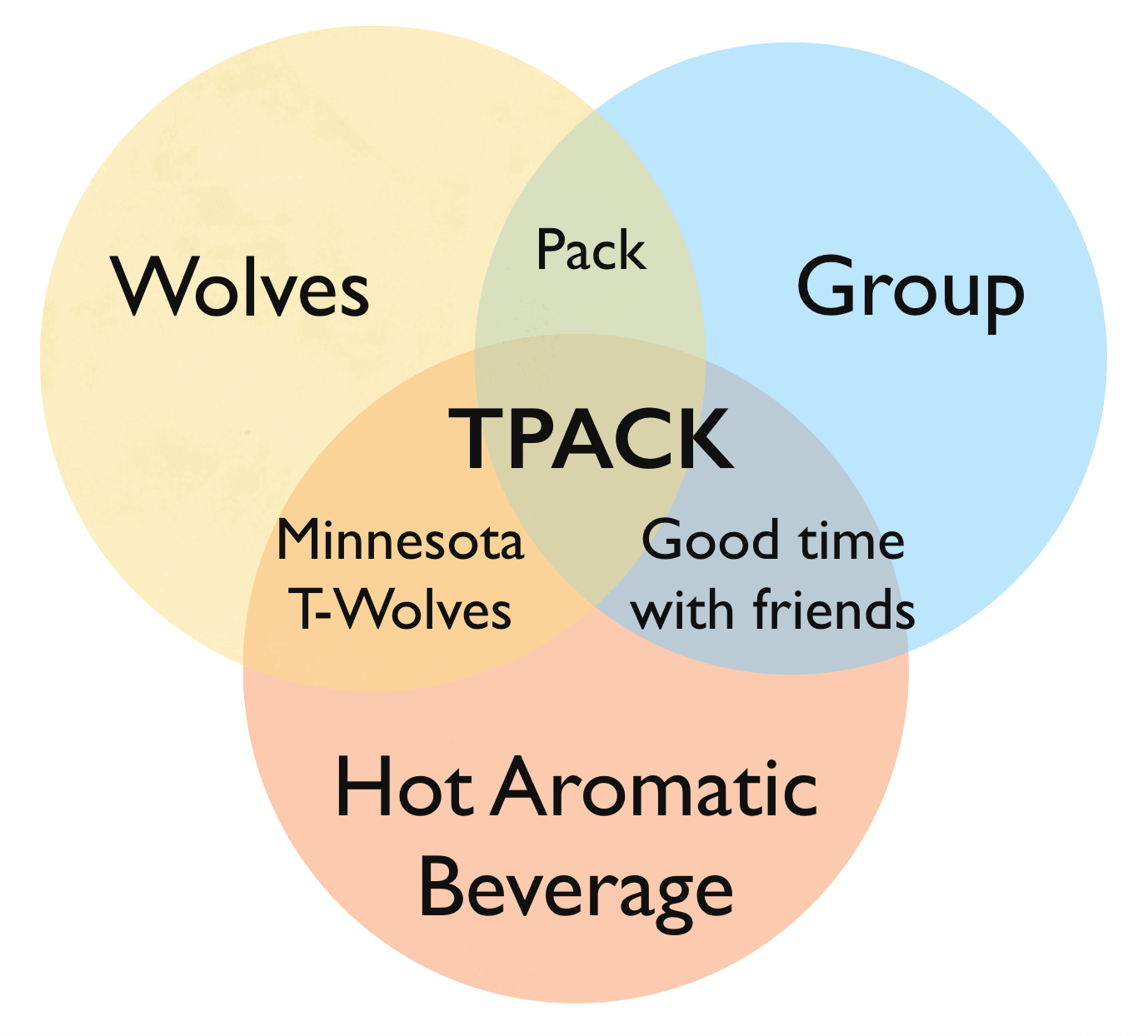
<p style="padding-left: 30px;">When I think of the <a class = 'linkit' href='http://punya.educ.msu.edu/research/tpck/' rel='external ' title=''>TPACK</a> diagram, I picture horseshoe magnets on the outside of each circle, pointed into the middle. Those magnets are what keep the quality teacher balanced in the center, each magnet pulling and building a feeling of equilibrium. This is obviously best-case scenario.</p>
<p>He describes the evolving knowledge of the teacher as (and I love this phrase) <strong>Journey to the Center of the Venn. </strong>As <a class = 'linkit' href='http://mkoehler.educ.msu.edu/' rel='external ' title='Matthew Koehler's webpage'>Matt Koehler</a> and I have written earlier, we see all good teachers as sitting right in the middle of the three intersecting circles. Elsewhere we had written:</p>
<p style="padding-left: 30px;">Clearly, separating the three components (content, pedagogy and technology) in our model is an analytic act and one that is difficult to tease out in practice. In actuality these components exist in a state of dynamic equilibrium, or as the philosopher Kuhn (1977) said in a different context, in a state of “essential tension.” (This is in our original <a href="http://punya.educ.msu.edu/2008/01/12/mishra-koehler-2006/">TC Record article</a> that introduced the <a class = 'linkit' href='http://punya.educ.msu.edu/research/tpck/' rel='external ' title=''>TPACK</a> construct, though it was then called TPCK. I am sure we have written about this elsewhere as well, but I am being a bit lazy here.)</p>
<p><span id="more-1193"></span>It seems to me that this idea of &#8220;essential tension&#8221; is exactly the point that Russ is making with his magnet analogy (which actually may be more user-friendly, so I might actually steal it for future use). Every teacher, we would argue, is pulled in different directions by the imperatives of the technology, of the content, and the pedagogy. The trick (and this where design comes in, this is where creativity comes in) is finding the right balance between the three.</p>
<p>The other question that Russ raises is how do teachers get to the Center of the Venn. He describes that most people get there through the technology &#8211; and that can be problematic since &#8220;that magnet&#8221; is extremely powerful. Over the past few years I have had the opportunity to present the <a class = 'linkit' href='http://punya.educ.msu.edu/research/tpck/' rel='external ' title=''>TPACK</a> framework to many different audiences and I have always found their responses extremely interesting.</p>
<p>To the technologists, the lack of emphasis on the transformative possibilities of technology is troublesome. Other audiences, say traditional educational psychologists, take us to task for giving Technology too much prominence. For them it is all about the Pedagogy (or instructional design)! Technology is in essence a pipe (or a dump-truck) and Content is irrelevant, since with the &#8220;right&#8221; pedagogical strategies one can teach anything. Content experts, on the other hand, are concerned by the fact that we are emphasizing P and (or) T over Content, or, at the very least, giving these three knowledge areas equal value. In their frame, disciplinary knowledge is all there is &#8211; the rest is just methods for getting information from one location (my head, a textbook) to another (students head). Teacher educators often get the PCK part (Shulman&#8217;s work has been around a while), they are, however, somewhat suspicious of these new technologies, it all seems too new and untested. Interactions with these different perspectives leaves me with a deeper understanding of how our professions or training frame our worldviews as well as a richer conceptualization of the framework as well.</p>
<p>The larger point I am trying to make here (in response to Russ&#8217; question) is that it doesn&#8217;t really matter where we come from, content, technology or pedagogy &#8211; at the end of the day we have to end up at the Center of the Venn Diagram. So in some sense everybody&#8217;s Journey to the Center will be somewhat different.</p>
<p><em><strong>Just a side note:</strong> Some of my posting above is cribbed from a discussion I participated in on <a href="http://www.classroom20.com/forum/topics/tpack-a-framework-for" target="_blank">Classroom 2.0.</a> Incidentally this discussion was initiated by <a href="http://mctownsley.blogspot.com/" target="_blank">Matt Townsley</a> (who turns out to be Russ&#8217; brother-in-law!). What a small world we live in <img src='http://punya.educ.msu.edu/wp-includes/images/smilies/icon_smile.gif' alt=':-)' class='wp-smiley' /><br />
</em></p>
]]></content:encoded>
			<wfw:commentRss>http://punya.educ.msu.edu/2010/02/03/interesting-tpack-related-discussion/feed/</wfw:commentRss>
		<slash:comments>0</slash:comments>
		</item>
		<item>
		<title>Cellphone in classrooms: The Saline story</title>
		<link>http://punya.educ.msu.edu/2010/02/01/cellphone-in-classrooms-the-saline-story/</link>
		<comments>http://punya.educ.msu.edu/2010/02/01/cellphone-in-classrooms-the-saline-story/#comments</comments>
		<pubDate>Mon, 01 Feb 2010 15:52:00 +0000</pubDate>
		<dc:creator>Punya Mishra</dc:creator>
				<category><![CDATA[Creativity]]></category>
		<category><![CDATA[Design]]></category>
		<category><![CDATA[Learning]]></category>
		<category><![CDATA[TPACK]]></category>
		<category><![CDATA[Teaching]]></category>
		<category><![CDATA[Technology]]></category>
		<category><![CDATA[Video]]></category>
		<category><![CDATA[Worth Reading]]></category>
		<category><![CDATA[cellphone]]></category>
		<category><![CDATA[classroom]]></category>
		<category><![CDATA[Saline]]></category>

		<guid isPermaLink="false">http://punya.educ.msu.edu/?p=1185</guid>
		<description><![CDATA[From the Saline Schools, right here in Michigan, comes a video about how teachers and students are using cellphone in the classroom to enhance teaching and learning. Check it out

h/t Superintendent Scot Graden&#8217;s Blog
]]></description>
			<content:encoded><![CDATA[<p>From the <a href="http://www.salineschools.com/" target="_blank">Saline Schools</a>, right here in Michigan, comes a video about how teachers and students are using cellphone in the classroom to enhance teaching and learning. Check it out</p>
<p><object classid="clsid:d27cdb6e-ae6d-11cf-96b8-444553540000" width="400" height="227" codebase="http://download.macromedia.com/pub/shockwave/cabs/flash/swflash.cab#version=6,0,40,0"><param name="allowfullscreen" value="true" /><param name="allowscriptaccess" value="always" /><param name="src" value="http://vimeo.com/moogaloop.swf?clip_id=9002398&amp;server=vimeo.com&amp;show_title=1&amp;show_byline=1&amp;show_portrait=0&amp;color=&amp;fullscreen=1" /><embed type="application/x-shockwave-flash" width="400" height="227" src="http://vimeo.com/moogaloop.swf?clip_id=9002398&amp;server=vimeo.com&amp;show_title=1&amp;show_byline=1&amp;show_portrait=0&amp;color=&amp;fullscreen=1" allowscriptaccess="always" allowfullscreen="true"></embed></object></p>
<p>h/t <a href="http://blogs.salineschools.com/gradens/" target="_blank">Superintendent Scot Graden&#8217;s Blog</a></p>
]]></content:encoded>
			<wfw:commentRss>http://punya.educ.msu.edu/2010/02/01/cellphone-in-classrooms-the-saline-story/feed/</wfw:commentRss>
		<slash:comments>0</slash:comments>
		</item>
		<item>
		<title>Deconstructing TV news</title>
		<link>http://punya.educ.msu.edu/2010/01/29/deconstructing-tv-news/</link>
		<comments>http://punya.educ.msu.edu/2010/01/29/deconstructing-tv-news/#comments</comments>
		<pubDate>Fri, 29 Jan 2010 21:35:11 +0000</pubDate>
		<dc:creator>Punya Mishra</dc:creator>
				<category><![CDATA[Art]]></category>
		<category><![CDATA[Creativity]]></category>
		<category><![CDATA[Film]]></category>
		<category><![CDATA[Fun]]></category>
		<category><![CDATA[Good | Bad Design]]></category>
		<category><![CDATA[Stories]]></category>
		<category><![CDATA[Worth Reading]]></category>
		<category><![CDATA[funny]]></category>
		<category><![CDATA[media criticism]]></category>
		<category><![CDATA[TV news]]></category>

		<guid isPermaLink="false">http://punya.educ.msu.edu/?p=1181</guid>
		<description><![CDATA[The video below has been getting a lot of attention on the blogs lately, and despite that it is pretty good. No kittens riding skateboards or mentos and Coke here. Just a beautifully constructed take down of TV News. A must see for all media literacy courses.
Check it out.
]]></description>
			<content:encoded><![CDATA[<p>The video below has been getting a lot of attention on the blogs lately, and despite that it is pretty good. No kittens riding skateboards or mentos and Coke here. Just a beautifully constructed take down of TV News. A must see for all media literacy courses.</p>
<p>Check it out.</p>
<p><a href="http://punya.educ.msu.edu/2010/01/29/deconstructing-tv-news/"><em>Click here to view the embedded video.</em></a></p>
]]></content:encoded>
			<wfw:commentRss>http://punya.educ.msu.edu/2010/01/29/deconstructing-tv-news/feed/</wfw:commentRss>
		<slash:comments>1</slash:comments>
		</item>
		<item>
		<title>Unlocking education&#8230; news story</title>
		<link>http://punya.educ.msu.edu/2010/01/29/unlocking-education-news-story/</link>
		<comments>http://punya.educ.msu.edu/2010/01/29/unlocking-education-news-story/#comments</comments>
		<pubDate>Fri, 29 Jan 2010 19:27:13 +0000</pubDate>
		<dc:creator>Punya Mishra</dc:creator>
				<category><![CDATA[Learning]]></category>
		<category><![CDATA[MAET]]></category>
		<category><![CDATA[Online Learning]]></category>
		<category><![CDATA[Teaching]]></category>
		<category><![CDATA[Technology]]></category>
		<category><![CDATA[leigh wolf]]></category>
		<category><![CDATA[open source]]></category>
		<category><![CDATA[state news]]></category>

		<guid isPermaLink="false">http://punya.educ.msu.edu/?p=1178</guid>
		<description><![CDATA[Our very own Leigh Wolf is quoted in a story in today&#8217;s State News. Check out, Education unlocked: MSU professors use open courseware to provide class materials for students
Leigh manages to bring in the MAET is a graduate level program that openly recruits potential students by posting course modules and examples of student work on [...]]]></description>
			<content:encoded><![CDATA[<p>Our very own <a class = 'linkit' href='http://www.msu.edu/~gravesle/' rel='external ' title=''>Leigh Wolf</a> is quoted in a story in today&#8217;s State News. Check out, <a href="http://www.statenews.com/index.php/article/2010/01/education_unlocked" target="_blank">Education unlocked: MSU professors use open courseware to provide class materials for students</a></p>
<p>Leigh manages to bring in the <a class = 'linkit' href='http://edutech.msu.edu/' rel='external ' title='Master's in Educational Technology'>MAET</a> program in to the picture (why am I not surprised?) and how we have been using some of these technologies for recruitment and community building. Here is a quote (though you should go read the entire article, right?)</p>
<p style="padding-left: 30px;"><span id="more-1178"></span><a class = 'linkit' href='http://edutech.msu.edu/' rel='external ' title='Master's in Educational Technology'>MAET</a> is a graduate level program that openly recruits potential students by posting course modules and examples of student work on its Web site, Graves said.</p>
<p style="padding-left: 30px;">“It really gives potential students an idea of what we’re about or current students something to point at to show what their education in our master’s program consists of and the types of work that they would be doing and ideas for inspiring other work that they may do,” Wolf said.</p>
<p style="padding-left: 30px;">Allowing non-students to access course information has generated a lot of interest in the program, both from potential students and colleagues, she said.</p>
<p style="padding-left: 30px;">Along with e-mails from curious students, the program has been contacted by educators who want to borrow some of the information on the site for their own classes, Wolf said.</p>
<p style="padding-left: 30px;">“The way of the social world right now is give and take,” she said. “We’re content producers and content consumers.”</p>
]]></content:encoded>
			<wfw:commentRss>http://punya.educ.msu.edu/2010/01/29/unlocking-education-news-story/feed/</wfw:commentRss>
		<slash:comments>0</slash:comments>
		</item>
		<item>
		<title>The infinity of primes (proof as poem)</title>
		<link>http://punya.educ.msu.edu/2010/01/27/the-infinity-of-primes-proof-as-poem/</link>
		<comments>http://punya.educ.msu.edu/2010/01/27/the-infinity-of-primes-proof-as-poem/#comments</comments>
		<pubDate>Wed, 27 Jan 2010 18:45:50 +0000</pubDate>
		<dc:creator>Punya Mishra</dc:creator>
				<category><![CDATA[Art]]></category>
		<category><![CDATA[Creativity]]></category>
		<category><![CDATA[Design]]></category>
		<category><![CDATA[Fun]]></category>
		<category><![CDATA[Good | Bad Design]]></category>
		<category><![CDATA[Learning]]></category>
		<category><![CDATA[Mathematics]]></category>
		<category><![CDATA[Personal]]></category>
		<category><![CDATA[Poetry]]></category>
		<category><![CDATA[Puzzles]]></category>
		<category><![CDATA[Representation]]></category>
		<category><![CDATA[Research]]></category>
		<category><![CDATA[Stories]]></category>
		<category><![CDATA[Teaching]]></category>
		<category><![CDATA[Worth Reading]]></category>
		<category><![CDATA[euclid]]></category>
		<category><![CDATA[infinity]]></category>
		<category><![CDATA[poem]]></category>
		<category><![CDATA[primes]]></category>
		<category><![CDATA[proof]]></category>

		<guid isPermaLink="false">http://punya.educ.msu.edu/?p=1162</guid>
		<description><![CDATA[The math-po (and sci-po) stream keeps flowing. Math Mama Writes, who started the whole math-poetry movement has some more on her blog, and here is Erin Nash with some really beautiful biological poetry. And of course, here&#8217;s her husband Sean Nash having his students writing poetry too. Of course let&#8217;s not forget my daughter Shreya [...]]]></description>
			<content:encoded><![CDATA[<p>The math-po (and sci-po) stream keeps flowing. <strong>Math Mama Writes</strong>, who started the whole math-poetry movement <a href="http://mathmamawrites.blogspot.com/2010/01/challenge-write-kids-poem-about-math.html" target="_blank">has some more on her blog</a>, and here is <strong>Erin Nash</strong> with some <a href="http://nashosphere.edublogs.org/" target="_blank">really beautiful biological poetry</a>. And of course, here&#8217;s her husband <strong>Sean Nash</strong> having <a href="http://mwsu-bio101.ning.com/forum/topics/pushing-scientific-thought" target="_blank">his students writing poetry too</a>. Of course let&#8217;s not forget my daughter <strong>Shreya</strong> (who sort of started this whole thing) and her sci-po&#8217;s at her blog <a href="http://shreya-mishra.blogspot.com/" target="_blank">Uniquely Mine</a>.</p>
<p>Below are some thoughts about math-poetry &#8211; but you can ignore all that and scroll right down to the poem: <strong>The infinity of primes!</strong></p>
<p style="text-align: center;"><img class="aligncenter" title="math art" src="http://farm3.static.flickr.com/2429/3711570425_0b8f502ca6.jpg" alt="" width="240" height="264" /><br />
Math art by <strong><a href="http://www.flickr.com/photos/durentu/"><strong>durentu</strong></a></strong></p>
<p>Through all this I have been plugging away at my math poetry. I know the original challenge was to write something to motivate students to learn math (and I did write <a href="http://punya.educ.msu.edu/2010/01/27/limerick-on-math-beauty/">one along those lines</a>). But more interesting to me has been this theme I have picked up, which is of writing proofs as poetry. I know many people have described mathematics in poetic terms but I am trying something slightly different here. I am trying to explain theorems (as in these couple of instances, see <a href="http://punya.educ.msu.edu/2010/01/13/a-tangent-a-line-a-circle-another-math-poem/">here</a>, <a href="http://punya.educ.msu.edu/2010/01/12/the-mathematical-i/">here</a>, <a href="http://punya.educ.msu.edu/2010/01/15/goldbach-is-back-new-math-poem/">here</a> and <a href="http://punya.educ.msu.edu/2010/01/12/math-po-mathematical-poetry-goldbachs-conjecture/">here</a>) and speficially in the poem included below, I am actually trying to construct a mathematical proof in rhyming verse.</p>
<p><span id="more-1162"></span>Sean Nash (of <a class = 'linkit' href='http://nashworld.edublogs.org/' rel='external ' title=''>Nashworld</a> and speaking in rhymes in biology class fame) in his post speaks of <a href="http://nashworld.edublogs.org/2010/01/18/is-this-a-sluggish-strategy/" target="_blank">a step by step process</a> that one follows when writing such poems. He writes of science but I think the same argument works for mathematics as well. One of the key things he writes is the value of summarizing, which I take to mean truly understanding something before you can translate it (in this case from prose to poetry). I am doing something similar here, where I take something written in mathematical language and translate it into rhyming verse.</p>
<p>The poem below was my attempt at writing a poetry version of Euclid&#8217;s proof that there are an infinite number of primes (<a href="http://primes.utm.edu/notes/proofs/infinite/euclids.html" target="_blank">see the actual mathematical proof</a>). What was interesting was that I started writing the poem based on my recollection of the proof. Once I had a draft I went off and found some actual proofs to link to &#8211; and then while reading them, I realized that I had made some subtle but critical mistakes in my poem. [For instance <a href="http://primes.utm.edu/notes/proofs/infinite/euclids.html" target="_blank">here is a page that gets it right</a>, and here is another that <a href="http://www.wanderings.net/notebook/Main/PrimeNumbersInfiniteEuclidProof" target="_blank">doesn't</a>.] Which meant that I had to go back to the editing table, and a few surgical strikes later, I had a poem that (at least to my eyes) is mathematically sound (its value as poetry is another matter altogether).</p>
<p style="text-align: center;"><img class="aligncenter" title="primes" src="http://farm3.static.flickr.com/2563/3896432339_b96c63d73a.jpg" alt="" width="326" height="326" /><br />
Prime Circle by <a href="http://www.flickr.com/photos/modern_carpentry/" target="_blank">modern_country</a></p>
<p>As I was doing this, it struck me that this act of writing poetry actually helped me learn and understand this proof. I can&#8217;t wait to get back home and share this understanding with my kids. So this poetry has a educative component, not necessarily for the ones reading it (they may as well read the proof in its mathematical form, it isn&#8217;t that hard, it is shorter, and they don&#8217;t have to deal with my forced rhymes). But it did help <em>me</em> learn.</p>
<p>So this is a good example of how the process of constructing something (the act of design) can be as important, maybe more so, than the actual product that emerges. So the proof of the pudding is not necessarily in the eating but rather may lie in the cooking. But here the proof of the proof lies in the creating not in the reading, but I include the pudding (er&#8230; I mean poem) here anyway, for the record.</p>
<p style="padding-left: 90px;"><strong>The infinity of primes</strong></p>
<p style="padding-left: 120px;">Over numbers and their combinations if you sit and mull<br />
You will find that not one of them is uninteresting and dull.<br />
But it is a certain class of figures that most attention stirs<br />
Yes, I am speaking of those special ones, the prime numbers.</p>
<p style="padding-left: 90px;">Prime numbers are interesting, the mathematician posits,<br />
‘Cos they make up all the others, the so-called composites.<br />
Here’s an imperfect analogy, a simple little working rule,<br />
Consider the prime to be an atom, then a composite’s a molecule.</p>
<p style="padding-left: 90px;"><img class="alignnone" title="Prime numbers" src="http://farm5.static.flickr.com/4012/4262775481_4cbd909762.jpg" alt="" width="216" height="216" /><br />
<em>Prime numbers by <a href="http://www.flickr.com/photos/chrisinplymouth/" target="_blank">chrisinplymouth</a> </em><strong><a title="Link to chrisinplymouth's photostream" href="http://www.flickr.com/photos/chrisinplymouth/"><strong> </strong></a></strong></p>
<p style="padding-left: 120px;">To carry the chemical analogy completely out of bound,<br />
Consider these atoms (primes) as randomly strewn around<br />
Some here, others there, their patterns concealed<br />
Few sequences stand out, no deep design is revealed.</p>
<p style="padding-left: 90px;">As the ladder of digits you will climb<br />
Hoping to predict the appearance of a prime<br />
One fact stands out, above all else, as you stare<br />
Prime numbers become more and more rare.</p>
<p style="padding-left: 90px;"><img class="alignnone" title="Solitude of primes" src="http://3.bp.blogspot.com/_k-jdDpTxhEM/Srdk4aV8TdI/AAAAAAAADKY/TyfMYyU9IBQ/s400/prime001.jpg" alt="" width="186" height="245" /><br />
<em>The solitude of primes<br />
from <a href="http://www.viewfromheremagazine.com/2009_09_01_archive.html" target="_blank">View from Here Magazine</a></em></p>
<p style="padding-left: 120px;">In other words, there are fewer primes the higher you go<br />
Does this heightened rarity mean something, or no?<br />
Is there a prime that is the biggest one?<br />
If there is, finding it could be fun.</p>
<p style="padding-left: 90px;">Of course, there’s another option, it is clear<br />
Is it that primes get rarer but never disappear.<br />
They get fewer and fewer the further we see<br />
But they never really get done, on to infinity.</p>
<p style="padding-left: 120px;">Which of these two options is the one that&#8217;s true<br />
And how much arithmetic do you have to do<br />
To show whether the primes are finite or not?<br />
Ideally via a nice elegant proof, in one clean shot.</p>
<p style="padding-left: 120px;"><img class="alignnone" title="Euclid shows the way" src="http://farm3.static.flickr.com/2047/2335673197_9375ff6b3f.jpg" alt="" width="200" height="150" /><br />
<em>Euclid by <a href="http://www.flickr.com/photos/waxesstatic/" target="_blank">waxesstatic</a> on Flickr</em></p>
<p style="padding-left: 90px;">Euclid, the geometry guy, comes to the rescue<br />
And produced a cool little proof, whew!<br />
So here&#8217;s my attempt to show in rhyme<br />
There’s no such thing as the largest prime.<br />
But don’t take my word for this information<br />
Let us take a moment to look at Euclid’s creation.</p>
<p style="padding-left: 120px;">Now here’s a critical (and smart) mathematical move<br />
Euclid said, that in order the converse to prove,<br />
Let’s start by assuming there is one (whatever it may be)<br />
Let’s give it a name, this biggest prime, let’s call it p.<br />
This largest prime, (p) when all is said and done<br />
Is divisible just by itself and the number 1.</p>
<p style="padding-left: 90px;">Now lets multiply together all these primes we have, then<br />
We get a humungous number, we shall, for now, call N.<br />
(This number we shall capitalize<br />
To represent its rather large numerical size.)<br />
Because N is the product of every prime we know,<br />
It is divisible by every one of them, that&#8217;s easy to show.</p>
<p style="padding-left: 120px;">Now take this N and to it, just add 1 (that’s all)<br />
A difference that you may consider as insignificant and small.<br />
But think about it for a moment and you may see<br />
What a difference this addition makes to divisibility.</p>
<p style="padding-left: 120px;"><img class="alignnone" title="divisibility" src="http://www.mathsisfun.com/images/apples-15.jpg" alt="" width="277" height="239" /><br />
<em>Divisibility, Image from <a href="http://www.mathsisfun.com/definitions/divisible.html" target="_blank">Math is fun</a></em></p>
<p style="padding-left: 90px;">This new number N + 1 you will soon realize<br />
In the case of divisibility can really surprise.<br />
Take any number on our list including p, our largest prime.<br />
N+1 is not divisible by any of these atoms of the number line.<br />
Whichever way you put N+1 through the division blender<br />
You will always be left behind with one solitary remainder!</p>
<p style="padding-left: 120px;">Stay with us for a moment, we are almost done<br />
In fact, this is where it gets to be kinda fun.<br />
Notice, there are just two possibilities at this juncture<br />
Let us, in turn, consider each conjecture.</p>
<p style="padding-left: 120px;"><img class="alignnone" title="Fork in the road" src="http://farm4.static.flickr.com/3537/3634166964_fdbc966fd2.jpg" alt="" width="193" height="238" /><br />
Fork on the road by <a href="http://www.flickr.com/photos/jessijoys/" target="_blank">Jessi Joy</a></p>
<p style="padding-left: 90px;">Either N+1 is a prime, or it is not.<br />
If it is a prime, our assumption is shot!<br />
For N+1 is clearly<br />
Much bigger than p!<br />
Something that contradicts what we started with<br />
The idea that p is the largest prime must be a myth</p>
<p style="padding-left: 120px;">Or, it could be that N+1 is a number composite<br />
Implying there are some primes that can cleanly divide it.<br />
One thing for sure, this divisor cannot be<br />
A prime in our original list we see.<br />
‘cos we just showed that dividing N+1<br />
By primes in the first list just cannot be done!</p>
<p style="padding-left: 90px;">This just means, there are some primes we missed<br />
When we were building our initial complete list.<br />
And if we missed one, you can sure<br />
There are just an infinity more.<br />
Isn’t it time you said to me<br />
Those magical words, QED.</p>
<p style="padding-left: 120px;">To sum up, the finite prime set idea is pure fiction<br />
Since assuming it leads to a contradiction.<br />
Primes may be rarer and rarer the higher we go<br />
But they do go on forever, and <em>this</em> Euclid did show.</p>
<p style="padding-left: 120px;"><img class="alignnone size-full wp-image-1190" title="Infinity_s" src="http://punya.educ.msu.edu/wp-content/uploads/2010/01/Infinity_s.jpg" alt="" width="267" height="200" /></p>
<p style="padding-left: 120px;">Infinity by <a href="http://www.sgeier.net/home.html" target="_blank">Sven Geier</a></p>
<p style="padding-left: 60px;">
]]></content:encoded>
			<wfw:commentRss>http://punya.educ.msu.edu/2010/01/27/the-infinity-of-primes-proof-as-poem/feed/</wfw:commentRss>
		<slash:comments>5</slash:comments>
		</item>
		<item>
		<title>Absolutely brilliant video</title>
		<link>http://punya.educ.msu.edu/2010/01/27/absolutely-brilliant-video/</link>
		<comments>http://punya.educ.msu.edu/2010/01/27/absolutely-brilliant-video/#comments</comments>
		<pubDate>Wed, 27 Jan 2010 05:21:36 +0000</pubDate>
		<dc:creator>Punya Mishra</dc:creator>
				<category><![CDATA[Art]]></category>
		<category><![CDATA[Creativity]]></category>
		<category><![CDATA[Design]]></category>
		<category><![CDATA[Film]]></category>
		<category><![CDATA[Fun]]></category>
		<category><![CDATA[Good | Bad Design]]></category>
		<category><![CDATA[Puzzles]]></category>
		<category><![CDATA[Representation]]></category>
		<category><![CDATA[TPACK]]></category>
		<category><![CDATA[Technology]]></category>
		<category><![CDATA[Worth Reading]]></category>
		<category><![CDATA[Video]]></category>

		<guid isPermaLink="false">http://punya.educ.msu.edu/?p=1158</guid>
		<description><![CDATA[
The Rethink Scholarship is an scholarship for aspiring art directors and designers to Langara College&#8217;s Communication and Ideation Design program. This video is to publicize the program.
]]></description>
			<content:encoded><![CDATA[<p style="text-align: center;"><object classid="clsid:d27cdb6e-ae6d-11cf-96b8-444553540000" width="400" height="225" codebase="http://download.macromedia.com/pub/shockwave/cabs/flash/swflash.cab#version=6,0,40,0"><param name="allowfullscreen" value="true" /><param name="allowscriptaccess" value="always" /><param name="src" value="http://vimeo.com/moogaloop.swf?clip_id=8766811&amp;server=vimeo.com&amp;show_title=0&amp;show_byline=0&amp;show_portrait=0&amp;color=ffffff&amp;fullscreen=1" /><embed type="application/x-shockwave-flash" width="400" height="225" src="http://vimeo.com/moogaloop.swf?clip_id=8766811&amp;server=vimeo.com&amp;show_title=0&amp;show_byline=0&amp;show_portrait=0&amp;color=ffffff&amp;fullscreen=1" allowscriptaccess="always" allowfullscreen="true"></embed></object></p>
<p>The Rethink Scholarship is an scholarship for aspiring art directors and designers to Langara College&#8217;s Communication and Ideation Design program. This video is to publicize the program.</p>
]]></content:encoded>
			<wfw:commentRss>http://punya.educ.msu.edu/2010/01/27/absolutely-brilliant-video/feed/</wfw:commentRss>
		<slash:comments>0</slash:comments>
		</item>
		<item>
		<title>Limerick on Math &amp; Beauty</title>
		<link>http://punya.educ.msu.edu/2010/01/27/limerick-on-math-beauty/</link>
		<comments>http://punya.educ.msu.edu/2010/01/27/limerick-on-math-beauty/#comments</comments>
		<pubDate>Wed, 27 Jan 2010 05:10:06 +0000</pubDate>
		<dc:creator>Punya Mishra</dc:creator>
				<category><![CDATA[Art]]></category>
		<category><![CDATA[Creativity]]></category>
		<category><![CDATA[Fun]]></category>
		<category><![CDATA[Mathematics]]></category>
		<category><![CDATA[Personal]]></category>
		<category><![CDATA[Poetry]]></category>
		<category><![CDATA[Worth Reading]]></category>
		<category><![CDATA[limerick]]></category>
		<category><![CDATA[math-po]]></category>

		<guid isPermaLink="false">http://punya.educ.msu.edu/?p=1153</guid>
		<description><![CDATA[
Image credit: eoliene_pe_campii
Mathematical Beauty: A limerick
Punya Mishra, Jan 27, 2010
Doesn’t it just gladden your heart to see
These games we can play with infinity?
How can one stay aloof
From the elegance of a proof
And remain immune to mathematics’ subtle beauty?
]]></description>
			<content:encoded><![CDATA[<p style="text-align: center;"><img class="alignnone" title="math beauty " src="http://eoliana.files.wordpress.com/2008/02/m.jpg" alt="" width="314" height="225" /><br />
Image credit: <a href="http://eoliana.wordpress.com/">eoliene_pe_campii</a></p>
<p style="padding-left: 60px;"><strong>Mathematical Beauty: A limerick<br />
</strong><em>Punya Mishra, Jan 27, 2010</em><strong></strong></p>
<p style="padding-left: 120px;">Doesn’t it just gladden your heart to see</p>
<p style="padding-left: 120px;">These games we can play with infinity?</p>
<p style="padding-left: 120px;">How can one stay aloof</p>
<p style="padding-left: 120px;">From the elegance of a proof</p>
<p style="padding-left: 120px;">And remain immune to mathematics’ subtle beauty?</p>
]]></content:encoded>
			<wfw:commentRss>http://punya.educ.msu.edu/2010/01/27/limerick-on-math-beauty/feed/</wfw:commentRss>
		<slash:comments>2</slash:comments>
		</item>
		<item>
		<title>Douglas Adams, technologies &amp; anticipatory plagiarism</title>
		<link>http://punya.educ.msu.edu/2010/01/26/douglas_adams_technologies_anticipatory_plagiarism/</link>
		<comments>http://punya.educ.msu.edu/2010/01/26/douglas_adams_technologies_anticipatory_plagiarism/#comments</comments>
		<pubDate>Tue, 26 Jan 2010 17:43:34 +0000</pubDate>
		<dc:creator>Punya Mishra</dc:creator>
				<category><![CDATA[Books]]></category>
		<category><![CDATA[Creativity]]></category>
		<category><![CDATA[Evolution]]></category>
		<category><![CDATA[Fun]]></category>
		<category><![CDATA[Personal]]></category>
		<category><![CDATA[Philosophy]]></category>
		<category><![CDATA[Plagiarism]]></category>
		<category><![CDATA[Publications]]></category>
		<category><![CDATA[Stories]]></category>
		<category><![CDATA[Teaching]]></category>
		<category><![CDATA[Technology]]></category>
		<category><![CDATA[Worth Reading]]></category>
		<category><![CDATA[anticipatory]]></category>
		<category><![CDATA[douglas adams]]></category>
		<category><![CDATA[hitchhikers guide to the galaxy]]></category>
		<category><![CDATA[JTATE]]></category>
		<category><![CDATA[koehler]]></category>
		<category><![CDATA[Matt]]></category>
		<category><![CDATA[SEP]]></category>

		<guid isPermaLink="false">http://punya.educ.msu.edu/?p=1148</guid>
		<description><![CDATA[
Image Credit Leeks
As readers of the blog know, ]]></description>
			<content:encoded><![CDATA[<p style="text-align: center;"><img class="alignnone" title="copy this, copy that" src="http://farm1.static.flickr.com/102/291632798_4642937c7e_m.jpg" alt="" width="240" height="180" /><br />
Image Credit <a href="http://www.flickr.com/photos/observatoryleak/">Leeks</a></p>
<p>As readers of the blog know, <a class = 'linkit' href='http://mkoehler.educ.msu.edu/' rel='external ' title='Matthew Koehler's webpage'>Matt Koehler</a> and I work together quite a lot. In fact we just rotate author-order in our papers since it is hard to keep track of individual contributions. (I would like to claim that the cool ideas are mine &#8211; but again he is bigger and stronger than me so I don&#8217;t often do that, at least not any more.) We are also huge fans of <a href="http://www.douglasadams.com/" target="_blank">Douglas Adams</a> and his <a href="http://www.douglasadams.com/creations/hhgg.html" target="_blank">Hitchhiker&#8217;s Guide to the Galaxy</a> trilogy (which consists of 4 books, something that makes perfect sense if you have ever read Adams). Anyway, a bunch of years ago we decided that we needed to act on our love for this man, and his writings, by citing him in an academic paper. To our great pride, we did it! In fact we started the article with a citation to Adams.</p>
<p><span id="more-1148"></span>Here is a citation to the article&#8230;</p>
<p style="padding-left: 30px;">Koehler, M. J., Mishra, P., Hershey, K., &amp; Peruski, L. (2004). With a little help from your students: A new model for faculty development and online course design. <em>Journal of Technology and Teacher Education, 12</em>(1), 25-55.</p>
<p>&#8230; and this is how the article began!</p>
<p style="padding-left: 30px;">The late Douglas Adams (1997), author of The Hitchhiker’s Guide to the Galaxy, uncovered an important principle relevant to educational technology—The Someone Else’s Problem (SEP) field. The SEP is a fictional technology that can make something “virtually invisible” because we think it is somebody else’s problem. It is not that the object in question really vanishes. It does not. It may in fact even catch you by surprise out of the corner of your eye. The idea of the SEP is that once we consider something as being outside of the arena of our concerns, that something, for all practical purposes, ceases to exist.</p>
<p style="text-align: center;"><img class="alignnone" title="douglas adams" src="http://blogs.nlb.gov.sg/ask/wp-content/uploads/2008/old3/DouglasAdams.jpg" alt="" width="200" /><br />
Douglas Adams, image credit <a href="http://blogs.nlb.gov.sg/ask/fiction/223" target="_blank">National Library Board, Singapore</a></p>
<p>How cool is that! Now, it turns out that our connections with Adams are even deeper than we knew. Recently we wrote another article&#8230;</p>
<p style="padding-left: 30px;">Mishra, P., &amp; Koehler, M. J. (2009, May). <a href="http://punya.educ.msu.edu/2009/04/30/too-cool-for-school-using-the-tpack-framework/">Too Cool for School?</a> No Way! <em>Learning &amp; Leading with Technology, (36)</em>7. 14-18. [PDF download].</p>
<p>&#8230; where we wrote the following:</p>
<p style="padding-left: 30px;">Someone once suggested that technology is all the new stuff that appeared after we were born! The stuff that was around before we arrived on the planet we often take as a given. For instance, to most of us a car is not really a technology, while a website is. To children born in the 1990’s neither cars nor websites are examples of technology, iPods and Wii gaming systems are.</p>
<p style="text-align: center;"><img class="alignnone" title="new &amp; old" src="http://farm1.static.flickr.com/47/221860236_c3a0bf99bc_m.jpg" alt="" width="240" height="134" /><br />
Image credit, from <a href="http://www.flickr.com/photos/pressthebuttononthetop/">littledan77</a></p>
<p>Now I remember writing this sentence (or do remember first reading it in Matt&#8217;s draft?). The point is that when we wrote &#8220;Someone once suggested&#8230;&#8221; we didn&#8217;t really think that someone had suggested it. That was just a rhetorical move, a way of sounding credible and being modest all at the same time. But guess what? Douglas Adams did say something exactly like this &#8211; only better. In his last book&#8230;</p>
<p style="padding-left: 30px;">Adams, D. (2002). <em>The salmon of doubt: Hitchhiking the galaxy one last time.</em> New York: Harmony Books.</p>
<p>&#8230; which is actually a collection of pieces he had written here and there I came across the following:</p>
<p style="padding-left: 30px;">I&#8217;ve come up with a set of rules that describe our reactions to technologies:</p>
<blockquote>
<ol>
<li style="padding-left: 30px;">Anything that is in the world when you&#8217;re born is normal and ordinary and is just a natural part of the way the world works.</li>
<li style="padding-left: 30px;">Anything that&#8217;s invented between when you&#8217;re fifteen and thirty-five is new and exciting and revolutionary and you can probably get a career in it.</li>
<li style="padding-left: 30px;">Anything invented after you&#8217;re thirty-five is against the natural order of things.  (p. 95).</li>
</ol>
</blockquote>
<p>Isn&#8217;t that just perfect! I now have another cool quote to use from Douglas Adams, and I don&#8217;t have to go the wimpy &#8220;Someone once suggested&#8230;&#8221; route.</p>
<p>The problem is that, I would still like Matt and me to take credit for this, I mean, so what if Douglas Adams wrote this years ago!, we came up with it independently (our weasel language notwithstanding).  My colleague Patrick Dickson has a phrase he uses that I think may help solve our problem. According to him, we deserve full credit for the idea, because Adams committed &#8220;anticipatory plagiarism.&#8221; Dickson defines Anticipatory Plagiarism as occuring &#8220;when someone steals your original idea and publishes it a hundred years before you were born.&#8221;</p>
<p>Somewhat appropriately, and for some strange reason, the Interwebs claim that this definition of &#8220;anticipatory plagiarism&#8221; was  first written by Robert Merton (for instance see <a href="http://quote.robertgenn.com/getquotes.php?catid=228" target="_blank">this page</a>). It is any surprise that Dickson is claiming anticipatory plagiarism by Merton!</p>
]]></content:encoded>
			<wfw:commentRss>http://punya.educ.msu.edu/2010/01/26/douglas_adams_technologies_anticipatory_plagiarism/feed/</wfw:commentRss>
		<slash:comments>2</slash:comments>
		</item>
		<item>
		<title>TPACK survey, new journal article</title>
		<link>http://punya.educ.msu.edu/2010/01/24/tpack-survey-new-journal-article/</link>
		<comments>http://punya.educ.msu.edu/2010/01/24/tpack-survey-new-journal-article/#comments</comments>
		<pubDate>Sun, 24 Jan 2010 18:24:39 +0000</pubDate>
		<dc:creator>Punya Mishra</dc:creator>
				<category><![CDATA[Design]]></category>
		<category><![CDATA[Learning]]></category>
		<category><![CDATA[Psychology]]></category>
		<category><![CDATA[Publications]]></category>
		<category><![CDATA[Research]]></category>
		<category><![CDATA[TPACK]]></category>
		<category><![CDATA[Teaching]]></category>
		<category><![CDATA[Technology]]></category>
		<category><![CDATA[Worth Reading]]></category>
		<category><![CDATA[Writing]]></category>
		<category><![CDATA[instrument]]></category>
		<category><![CDATA[preservice]]></category>
		<category><![CDATA[reliability]]></category>
		<category><![CDATA[survey]]></category>
		<category><![CDATA[teachers]]></category>
		<category><![CDATA[validity]]></category>

		<guid isPermaLink="false">http://punya.educ.msu.edu/?p=1146</guid>
		<description><![CDATA[Hot off the press:
Schmidt, D. A., Baran, E., Thompson, A. D.,  Mishra, P.,  Koehler, M.J. &#38; Shin, T. S. (2010). Technological Pedagogical Content Knowledge (TPACK): The development and validation of an assessment instrument for preservice teachers. Journal of Research on Technology in Education, 42(2), 123 &#8211; 149.
Abstract: Based in Shulman&#8217;s idea of Pedagogical Content Knowledge, [...]]]></description>
			<content:encoded><![CDATA[<p>Hot off the press:</p>
<p style="padding-left: 30px;">Schmidt, D. A., Baran, E., Thompson, A. D.,  Mishra, P.,  Koehler, M.J. &amp; Shin, T. S. (2010). <a href="http://punya.educ.msu.edu/publications/schmidt-et.al.2010.pdf">Technological Pedagogical Content Knowledge (TPACK): The development and validation of an assessment instrument for preservice teachers</a>. <em>Journal of Research on Technology in Education, 42</em>(2), 123 &#8211; 149.</p>
<p style="padding-left: 30px;">Abstract: Based in Shulman&#8217;s idea of Pedagogical Content Knowledge, Technological Pedagogical Content Knowledge (<a class = 'linkit' href='http://punya.educ.msu.edu/research/tpck/' rel='external ' title=''>TPACK</a>) has emerged as a useful frame for describing and understanding the goals for technology use in preservice teacher education. This paper addresses the need for a survey instrument designed to assess <a class = 'linkit' href='http://punya.educ.msu.edu/research/tpck/' rel='external ' title=''>TPACK</a> for preservice teachers. The paper describes the survey development process and results from a pilot study on 124 preservice teachers. Data analysis procedures included Cronbach&#8217;s alpha statistics on the <a class = 'linkit' href='http://punya.educ.msu.edu/research/tpck/' rel='external ' title=''>TPACK</a> knowledge domains and factor analysis for each domain. Results suggest that, with the modification and/or deletion of 18 of the survey items, the survey is a reliable and valid instrument that will help educators design longitudinal studies to assess perservice teachers&#8217; development of <a class = 'linkit' href='http://punya.educ.msu.edu/research/tpck/' rel='external ' title=''>TPACK</a>. (Keywords: <a class = 'linkit' href='http://punya.educ.msu.edu/research/tpck/' rel='external ' title=''>TPACK</a>, instrument development, preservice teachers)</p>
<p><em><em></em></em></p>
]]></content:encoded>
			<wfw:commentRss>http://punya.educ.msu.edu/2010/01/24/tpack-survey-new-journal-article/feed/</wfw:commentRss>
		<slash:comments>0</slash:comments>
		</item>
		<item>
		<title>The futility of existence</title>
		<link>http://punya.educ.msu.edu/2010/01/24/the-futility-of-existence/</link>
		<comments>http://punya.educ.msu.edu/2010/01/24/the-futility-of-existence/#comments</comments>
		<pubDate>Sun, 24 Jan 2010 17:00:50 +0000</pubDate>
		<dc:creator>Punya Mishra</dc:creator>
				<category><![CDATA[Art]]></category>
		<category><![CDATA[Creativity]]></category>
		<category><![CDATA[Design]]></category>
		<category><![CDATA[Engineering]]></category>
		<category><![CDATA[Fun]]></category>
		<category><![CDATA[Philosophy]]></category>
		<category><![CDATA[Puzzles]]></category>
		<category><![CDATA[Stories]]></category>
		<category><![CDATA[auto-switch-off]]></category>
		<category><![CDATA[futility]]></category>
		<category><![CDATA[machine]]></category>
		<category><![CDATA[Pessimism]]></category>
		<category><![CDATA[Sisyphus]]></category>

		<guid isPermaLink="false">http://punya.educ.msu.edu/?p=1142</guid>
		<description><![CDATA[I stumbled across this little machine that shuts itself off once it has been switched on! How cool is that. I don&#8217;t have an clue whom to credit it to and would appreciate a heads up on that. I was reminded of the myth of Sisyphus which led to a great piece of hand-drawn animation [...]]]></description>
			<content:encoded><![CDATA[<p>I stumbled across this little machine that shuts itself off once it has been switched on! How cool is that. I don&#8217;t have an clue whom to credit it to and would appreciate a heads up on that. I was reminded of the myth of Sisyphus which led to a great piece of hand-drawn animation on YouTube. So here they are&#8230; somewhat apt images for a dull, dreary day in mid-Michigan.</p>
<p style="text-align: center;"><img class="alignnone" title="auto switch off machine" src="http://d.yimg.com/gg/u/3b66e92ebfe6bf8ec98611545ee34ff7986fefa5.gifa" alt="" width="390" height="255" /></p>
<p>You can watch the <a href="http://www.youtube.com/watch?v=K5MdFdAe_JY" target="_blank">Sisyphus youtube video here</a>. And here is a link to another <a href="http://www.csun.edu/~vcpsy00h/images/sisyphus.gif" target="_blank">small animated gif about Sisyphus</a>.</p>
]]></content:encoded>
			<wfw:commentRss>http://punya.educ.msu.edu/2010/01/24/the-futility-of-existence/feed/</wfw:commentRss>
		<slash:comments>2</slash:comments>
		</item>
		<item>
		<title>The TPACK game, Littleton version</title>
		<link>http://punya.educ.msu.edu/2010/01/24/the-tpack-game-littleton-version/</link>
		<comments>http://punya.educ.msu.edu/2010/01/24/the-tpack-game-littleton-version/#comments</comments>
		<pubDate>Sun, 24 Jan 2010 16:49:03 +0000</pubDate>
		<dc:creator>Punya Mishra</dc:creator>
				<category><![CDATA[Blogging]]></category>
		<category><![CDATA[Creativity]]></category>
		<category><![CDATA[Design]]></category>
		<category><![CDATA[Good | Bad Design]]></category>
		<category><![CDATA[Learning]]></category>
		<category><![CDATA[Representation]]></category>
		<category><![CDATA[Research]]></category>
		<category><![CDATA[TPACK]]></category>
		<category><![CDATA[Teaching]]></category>
		<category><![CDATA[Technology]]></category>
		<category><![CDATA[Worth Reading]]></category>
		<category><![CDATA[colorado]]></category>
		<category><![CDATA[game]]></category>
		<category><![CDATA[littleton]]></category>
		<category><![CDATA[school wide]]></category>
		<category><![CDATA[technology integration]]></category>
		<category><![CDATA[tpack game]]></category>

		<guid isPermaLink="false">http://punya.educ.msu.edu/?p=1143</guid>
		<description><![CDATA[I received an email from Michael Porter of the Littleton Public Schools in Colorado about a version of the TPACK game Michael and his colleagues recently conducted with their K-12 Leadership team (building principals and district administrators). I know that ]]></description>
			<content:encoded><![CDATA[<p>I received an email from Michael Porter of the Littleton Public Schools in Colorado about a version of the <a class = 'linkit' href='http://punya.educ.msu.edu/research/tpck/' rel='external ' title=''>TPACK</a> game Michael and his colleagues recently conducted with their K-12 Leadership team (building principals and district administrators). I know that <a class = 'linkit' href='http://mkoehler.educ.msu.edu/' rel='external ' title='Matthew Koehler's webpage'>Matt Koehler</a> and I had discussed a <a class = 'linkit' href='http://punya.educ.msu.edu/research/tpck/' rel='external ' title=''>TPACK</a> mashup game in our <a href="http://punya.educ.msu.edu/2008/03/18/site-2008-keynote/">SITE 2008 Keynote</a> but what Michael and his colleagues have done is something different. Essentially they gave their participants a set of scenarios that they then had to evaluate using a <a class = 'linkit' href='http://punya.educ.msu.edu/research/tpck/' rel='external ' title=''>TPACK</a> lens. They ended up what  a set of &#8220;scatter plots&#8221; that reveal the manner in which each of the scenarios integrated technology, pedagogy and content. Read the post (<a href="http://www.littletonpublicschools.net/DISTRICTINFORMATION/GetInvolved/LPSBlogs/tabid/656/EntryId/375/The-TPaCK-Game.aspx" target="_blank">The TPACK game</a>) to see just how this plays out.</p>
<p style="text-align: center;"><img class="alignnone" title="TPACK game" src="http://www.littletonpublicschools.net/Portals/0/ITS/Technology/CIMG0170.JPG" alt="" width="500" /><br />
Photograph of &#8220;scatter plot&#8221; generated by the <a class = 'linkit' href='http://punya.educ.msu.edu/research/tpck/' rel='external ' title=''>TPACK</a> game,<br />
Image credit <a href="http://www.littletonpublicschools.net/DISTRICTINFORMATION/GetInvolved/LPSBlogs/tabid/656/EntryId/375/The-TPaCK-Game.aspx" target="_blank">Littleton Public Schools &amp; Michael Porter</a></p>
<p><span id="more-1143"></span>I do think that approaches such as this one are creative way to apply the <a class = 'linkit' href='http://punya.educ.msu.edu/research/tpck/' rel='external ' title=''>TPACK</a> framework to analyze and critique lesson plans and scenarios &#8211; to identify gaps leading to thinking deeper about how T, P &amp; C can be brought together.</p>
<p>Michael also mentioned a district-wide initiative (Inspired Writing) that connects &#8220;netbook technology with process writing in Language Arts classrooms.&#8221; You can find out more about it <a href="http://inspiredwriting.wikispaces.com/" target="_blank">here</a> &amp; <a href="http://www.littletonpublicschools.net/DISTRICTINFORMATION/GetInvolved/LPSBlogs/tabid/656/EntryId/342/Notable-Results.aspx">here</a>.</p>
<p>All pretty cool stuff and thanks to Michael for sharing.</p>
]]></content:encoded>
			<wfw:commentRss>http://punya.educ.msu.edu/2010/01/24/the-tpack-game-littleton-version/feed/</wfw:commentRss>
		<slash:comments>0</slash:comments>
		</item>
		<item>
		<title>Teaching design, some ideas</title>
		<link>http://punya.educ.msu.edu/2010/01/22/teaching-design/</link>
		<comments>http://punya.educ.msu.edu/2010/01/22/teaching-design/#comments</comments>
		<pubDate>Fri, 22 Jan 2010 15:40:44 +0000</pubDate>
		<dc:creator>Punya Mishra</dc:creator>
				<category><![CDATA[Art]]></category>
		<category><![CDATA[Creativity]]></category>
		<category><![CDATA[Design]]></category>
		<category><![CDATA[Engineering]]></category>
		<category><![CDATA[Fun]]></category>
		<category><![CDATA[Good | Bad Design]]></category>
		<category><![CDATA[Learning]]></category>
		<category><![CDATA[Mathematics]]></category>
		<category><![CDATA[Personal]]></category>
		<category><![CDATA[Philosophy]]></category>
		<category><![CDATA[Poetry]]></category>
		<category><![CDATA[Research]]></category>
		<category><![CDATA[Stories]]></category>
		<category><![CDATA[Teaching]]></category>
		<category><![CDATA[Technology]]></category>
		<category><![CDATA[Worth Reading]]></category>
		<category><![CDATA[curriculum]]></category>
		<category><![CDATA[Stop motion]]></category>

		<guid isPermaLink="false">http://punya.educ.msu.edu/?p=1136</guid>
		<description><![CDATA[I recently received an email from a teacher in Poland, seeking advice for a curriculum outline for their Design Technology Section. They said, and I quote:
Unfortunately, I have minimal experience with the subject as a teacher or as a student in my younger years, consequently, I have little background as to what a DT class [...]]]></description>
			<content:encoded><![CDATA[<p>I recently received an email from a teacher in Poland, seeking advice for a curriculum outline for their Design Technology Section. They said, and I quote:</p>
<p style="padding-left: 30px;">Unfortunately, I have minimal experience with the subject as a teacher or as a student in my younger years, consequently, I have little background as to what a DT class should look like.</p>
<p style="padding-left: 30px;">As you might guess I&#8217;m struggling trying to put together some sort of DT curriculum for our Middle School.</p>
<p style="padding-left: 30px;">Our small school does not not have any kind of fabrication equipment so our DT class is currently heavy on IT design aspects&#8230;.(web design, research on a topic and devise a solution, book creation,etc&#8230; )</p>
<p>The specific request was for&#8221;some useful and practical information that I can implement fairly easily.&#8221;</p>
<p style="text-align: center;"><img class="alignnone" title="Is this what design is?" src="http://farm1.static.flickr.com/108/250294832_7e552a9376_m.jpg" alt="" width="240" height="180" /><br />
<em>Is this what design is? by <a href="http://www.flickr.com/photos/stephenliveshere/">StephenMitchell</a> on Flickr</em></p>
<p>As I crafted the response I realized that (given my lazy self) that it would make a good blog post. So here is what I wrote back:</p>
<p style="padding-left: 30px;"><span id="more-1136"></span>Thank you for your note. I think a lot can be done with respect to design &#8211; even without fabrication equipment. Some of the first steps are what I think you are already doing (web design, book creation etc.) but the issue is deeper than engaging in &#8220;design&#8221; related activity. What may be more important is infusing design thinking (as a way of articulating problems and coming up with potential solutions) in the course, or courses, as the case may be. This design thinking is a broad framework that you can use to structure any kind of a situation that you give your students. In one of my classes, for instance I use the structure provided by Scott McCloud&#8217;s book Understanding Comics (with some modification related to user testing). For instance see this video that is a <a href="http://punya.educ.msu.edu/2009/12/31/nature-v-s-nurture-what-are-we-missing/" target="_self">link</a> on my website (the posting mentions and links to the video at the very beginning. See Awakening Creativity by George Kembel).</p>
<p style="padding-left: 30px;">The idea would be to use a structure like that to guide student activity.</p>
<p style="padding-left: 30px; text-align: center;"><img class="alignnone" title="Design is everything" src="http://farm1.static.flickr.com/90/244180342_7698fd2d52.jpg" alt="" width="385" height="242" /><br />
<span style="color: #999999;"><em>Design is about everything by <a href="http://www.flickr.com/photos/ballookey/" target="_blank">ballookey</a> on flickr. </em></span></p>
<p style="padding-left: 30px;">The actual task they do can vary a great deal. I constructed a set up in my basement for <a href="http://punya.educ.msu.edu/2009/12/30/happy-2010-stop-motion-movie/">my kids to make stop-motion movies</a> and <a href="http://punya.educ.msu.edu/2009/12/30/finding-nemo-the-seaquel/">this</a>.</p>
<p style="padding-left: 30px;">One great assignment would for kids to make educational toys from junk. See <a href="http://punya.educ.msu.edu/2009/09/14/jugaad-educational-toys-from-trash-tpack-at-work/">this</a> post, for instance where I write about Arvind Gupta who makes science toys.</p>
<p style="padding-left: 30px;">The idea is that design permeates all that we do. So in my classes I have people write short stories in 55 words and guess what, that is a process of design. Recently my daughter started writing scientific poems (Sci-Po&#8217;s for short) which has led to a high school in Missouri to do the same. I have also written a bunch of <a href="http://mwsu-bio101.ning.com/forum/topics/pushing-scientific-thought">mathematical poems</a>. More info with links to the <a href="http://punya.educ.msu.edu/2010/01/15/goldbach-is-back-new-math-poem/">high school kids work here</a>.</p>
<p style="padding-left: 30px;">A combination of the above can lead to lots of fascinating ideas and ways of thinking about technology and our relationship to it. The main goal is to get kids to think about themselves as &#8220;creators&#8221; or &#8220;designers&#8221; or technology, rather than mere users of it.</p>
<p style="padding-left: 30px;">There are more resources I can bring in to the conversation but I would like to hear back from you about what you think.</p>
<p style="padding-left: 30px;">Finally, I have to put in a plug for our Master&#8217;s program &#8211; I think that you would greatly benefit from it. You can find out more about this by going to <a href="http://edutech.msu.edu/" target="_blank">http://edutech.msu.edu/</a> Since you are in Poland you may be most interested in our summer offerings this year in Rouen in France. Do let me know if you have any questions about that.</p>
<p>So what do you think of what I wrote (ignoring the rather blatant plug at the end, which to my credit, I flag as being such)? I must add that this was written at one go, with no editing (pretty much) with little reflection or effort spent looking online for resources and ideas.</p>
<p>What would you add? What would you subtract?</p>
]]></content:encoded>
			<wfw:commentRss>http://punya.educ.msu.edu/2010/01/22/teaching-design/feed/</wfw:commentRss>
		<slash:comments>1</slash:comments>
		</item>
		<item>
		<title>For Sean &amp; his students</title>
		<link>http://punya.educ.msu.edu/2010/01/19/for-sean-his-students/</link>
		<comments>http://punya.educ.msu.edu/2010/01/19/for-sean-his-students/#comments</comments>
		<pubDate>Tue, 19 Jan 2010 18:56:31 +0000</pubDate>
		<dc:creator>Punya Mishra</dc:creator>
				<category><![CDATA[Art]]></category>
		<category><![CDATA[Biology]]></category>
		<category><![CDATA[Blogging]]></category>
		<category><![CDATA[Creativity]]></category>
		<category><![CDATA[Design]]></category>
		<category><![CDATA[Fun]]></category>
		<category><![CDATA[Learning]]></category>
		<category><![CDATA[Personal]]></category>
		<category><![CDATA[Philosophy]]></category>
		<category><![CDATA[Poetry]]></category>
		<category><![CDATA[Representation]]></category>
		<category><![CDATA[Science]]></category>
		<category><![CDATA[Teaching]]></category>
		<category><![CDATA[Worth Reading]]></category>
		<category><![CDATA[limericks]]></category>
		<category><![CDATA[poems]]></category>
		<category><![CDATA[Sci-Po]]></category>
		<category><![CDATA[sci-pos]]></category>
		<category><![CDATA[sean nash]]></category>
		<category><![CDATA[students]]></category>

		<guid isPermaLink="false">http://punya.educ.msu.edu/?p=1132</guid>
		<description><![CDATA[Sean had this wonderful post on his blog (Is this a sluggish strategy?) about this whole scientific and mathematical poetry that is going around. He links to some excellent sci-po&#8217;s written by his students (see Pushing Scientific Thought Into Art) and also provides a nice protocol for those who want to apply it in their [...]]]></description>
			<content:encoded><![CDATA[<p>Sean had this wonderful post on his blog (<a href="http://nashworld.edublogs.org/2010/01/18/is-this-a-sluggish-strategy/comment-page-1/#comment-664" target="_blank">Is this a sluggish strategy?</a>) about this whole scientific and mathematical poetry that is going around. He links to some excellent sci-po&#8217;s written by his students (see <a href="http://mwsu-bio101.ning.com/forum/topics/pushing-scientific-thought" target="_blank">Pushing Scientific Thought Into Art</a>) and also provides a nice protocol for those who want to apply it in their own classrooms.</p>
<p>It is amazing to me just how this idea has spread. It has en-livened my life, I can say that much. Anyway, I wanted to say thanks to Sean (and his students) &#8211; and what better way to say it than in verse. So here is: <em>For Sean &amp; his students</em></p>
<p><strong><span id="more-1132"></span>For Sean &amp; his students</strong></p>
<p style="padding-left: 90px;">There’s this high-school teacher named Sean Nash<br />
Never to scared to try anything pedagogically rash<br />
Having written an extended sci-po<br />
On his favorite subject, (no surprise) bio<br />
He now expected his students to add to the stash.</p>
<p style="padding-left: 30px;">Some people wonder, why? Why did Sean get this curse?<br />
I mean this is science class, what could be worse<br />
Than poems about bugs<br />
And photosynthesizing slugs?<br />
Please, they said, save kids from writing silly scientific verse.</p>
<p style="padding-left: 60px;">They are in class to learn, the critics say, their days to grind<br />
To strengthen and develop their test-taking mind<br />
Give them definitions to remember<br />
From January to December<br />
Did you forget the mandates of No child Left Behind?</p>
<p style="padding-left: 30px;">Sean looks at these critics, the nay-sayers, self-appointed<br />
Who critique him for approaches they feel are disjointed<br />
If you really want to see<br />
The value of this, come with me<br />
He says, his voice, for some reason, sharp and pointed</p>
<p style="padding-left: 60px;">The picture is different in the classroom, as students sweat<br />
Over the essence and meaning of science, they struggle and fret<br />
But with effort and time<br />
They hit on the perfect rhyme<br />
And when done, they share it worldwide, on the Internet.</p>
<p style="padding-left: 30px;">The value of what they do, the students, they do know it.<br />
And in their poems and other work they clearly show it<br />
Dichotomies they spurn<br />
As they create and learn<br />
The value or being both a scientist and a poet!</p>
]]></content:encoded>
			<wfw:commentRss>http://punya.educ.msu.edu/2010/01/19/for-sean-his-students/feed/</wfw:commentRss>
		<slash:comments>4</slash:comments>
		</item>
	</channel>
</rss>