
Punya Mishra is Associate Dean of Scholarship & Innovation and Professor in the Mary Lou Fulton Teachers College at Arizona State University (with an affiliate appointment in the Design School). As associate dean, he leads a range of initiatives that provides a future-forward, equity driven, approach to inter/trans-disciplinary educational research. He is internationally recognized for his work in educational technology; the role of creativity and aesthetics in learning; and the application of collaborative, design-based approaches to educational innovation. He has received over $11 million in grants; published over 200 articles and edited 5 books. With over 58,000 citations of his research, he is ranked among the top 2% of scientists worldwide and the top 50 scholars (top 10 in psychology) who have the biggest influence on educational practice and policy in the United States. An AERA Fellow (2024), TED-Ed educator (2023), he co-hosts the award-winning Silver Lining for Learning webinar as well as the Value Laden and Learning Futures podcasts. He is also an award-winning instructor, an engaging public speaker, and an accomplished visual artist and poet. More here…
Must reads

Webinars & Podcasts:
Value Laden (archived)
Apple | Spotify | Simplecast
Blog Posts
Metaphors, Minds, Technology & Learning
Note: The shared blogging experiment with Melissa Warr and Nicole Oster continues. This time we delve into metaphors of the mind, technology and generative AI. The core idea and first draft came from Melissa, to which I contributed a substantial rewrite. The final...
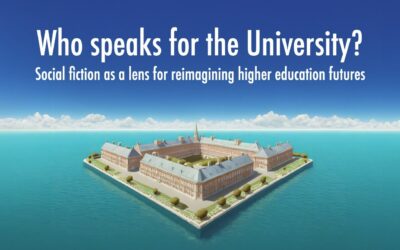
Who speaks for the university? Social fiction as a lens for reimagining higher education futures
Note: Image above created using Adobe Firefly, Photoshop and composed in Keynote. A few years ago, I had the pleasure of connecting with author Dr. Phoebe Wagner through the Center for Science and the Imagination at Arizona State University. We discussed her...
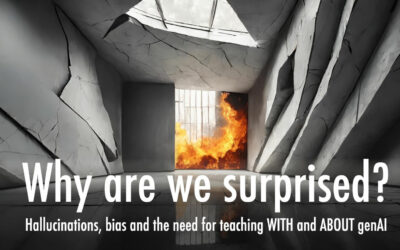
Why are we surprised? Hallucinations, bias and the need for teaching with and about genAI
By Punya Mishra, Melissa Warr & Nicole Oster Note: This is the first post in an experiment at shared blogging by Melissa Warr, Nicole Oster and myself. Over the past months we have found ourselves engaged in some fascinating conversations around genAI, education,...

SITE 2024: A recap
The Society for Information Technology in Teacher Education (SITE) conference has been an integral part of my professional journey for over two decades. My first presentation at SITE was back in 2001 with Matt Koehler and through the years, SITE has played a pivotal...
AI in Education: Potentials, Perils & Policies
NORRAG, based at the Geneva Graduate Institute, is a global network focused on international education policy and cooperation, known for its commitment to addressing under-researched topics related to education quality and equity and amplifying voices from the Global...
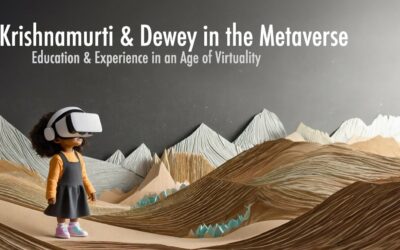
Krishnamurti & Dewey in the Metaverse: Education & Experience in an Age of Virtuality
What does it mean to have an educative experience? As Dewey famously wrote: The belief that all genuine education comes about through experience does not mean that all experiences are genuinely or equally educative ~ John Dewey Questions such as these come to...
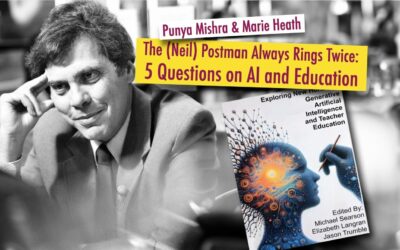
The (Neil) Postman Always Rings Twice: 5 Questions on AI and Education
Note: This post has also been cross-posted on the Civics of Technology blog. Marie Heath (with whom I recently co-wrote a blog post about GenAI in Teacher Education: A techno-skeptical perspective) and I were invited to write a chapter for an edited volume titled...
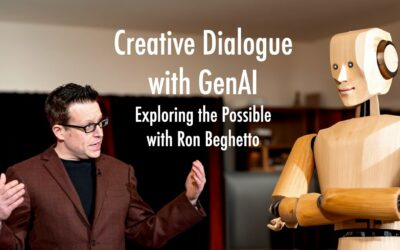
Creative dialogue with Generative AI: Exploring the Possible with Ron Beghetto
As part of our ongoing series for the journal TechTrends exploring the intersections of technology, education, and creativity, we have recently turned our focus to the potential impacts of generative AI (GenAI) on these domains. Our latest article features a...
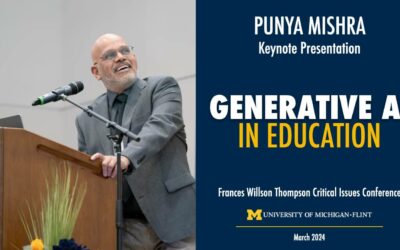
Generative AI in Education: Keynote at UofM-Flint
A couple of weeks ago I was invited to give a keynote at the Frances Willson Thompson Critical Issues Conference on Generative AI in Education. It was great to go back to Michigan even if for a super short trip. One of the pleasures of the visit was catching up with...
… or check out some random blog posts
Ideas are cool
My colleague and friend David Wong has this cool idea, about making ideas cool. Actually, he has been espousing these ideas for a while now (check out his scholarly publications, in particular The Rebirth of Cool [Word doc]). But now this academic has stepped out of...

Principled innovation in hiring
We, in the Office of Scholarship and Innovation (OofSI), have never been big fans of the typical interview and hiring process. We are not sure that the process helps us identify the right people, and more importantly, we find the process to be unnecessarily opaque and...
River run photos
Here are some photographs from the Capital City River Run half-marathon I completed this past Sunday (as reported here: Hurting but Happy). Here's one More here, here, here, here, here & here. Apologies for the copyright marks.
Rethinking Little Red Riding Hood
Awesome retelling of the old tale... (h/t Steve Dembo @ teach42). Slagsmålsklubben - Sponsored by destiny from Tomas Nilsson on Vimeo. As Steve says (you can read his full post here) such remixing can provide interesting opportunities for teachers, particularly given...
Announcing the Numeroscriptor, great quote
What a wonderful quote... Already every bank of any importance probably uses calculating machines. It is not likely that the fatiguing and uncertain process of having arithmetical calculations of any sort performed in the brains of clerks will survive the improvements...
TPACK goes Chinese… virtually
Matt Koehler and I had been asked to provide the plenary address at the Annual Meeting of Global Chinese Conference on Computers in Education (GCCCE) at East Lansing. As Jack Schwille said in an email to the College: Our Confucius Institute is hosting the 12th Global...
Mind(ful) Wandering & Creativity: New article
Illustration by Punya Mishra We have covered a wide range of issues related to creativity, technology and learning in our almost decade-long series that we write for the journal TechTrends. Over the past few years we have conducted almost 30+ interviews with some of...
Laptops in the classroom
Ira Socol has a great post on his blog (SpEdChange) titled Humiliation and the modern professor, in which he speaks to the issue of students bringing laptops to the classroom. Some professors have banned laptops from their classes (I personally know a couple who would...
Good Evil Ambigram
Brad Honeycutt, a fellow Spartan (he graduated 1996 a couple of years before I started here at Michigan State) is fascinated by optical illusions. He has completed a couple of books on optical illusions the first of which will be coming out in July. Scott Kim, one of...